





MENU
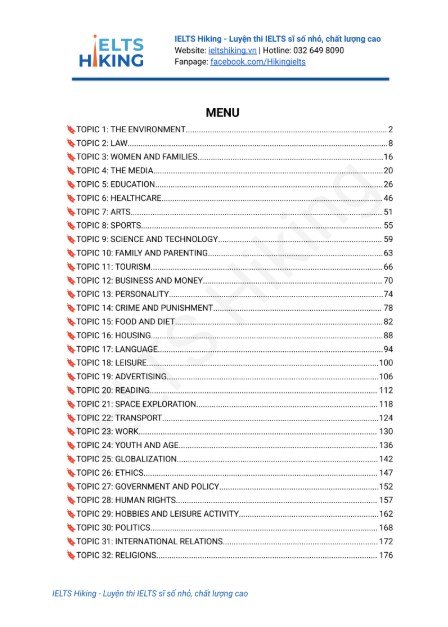
- TOPIC 1: THE ENVIRONMENT………………………………………………………….. 2
- TOPIC 2: LAW………………………………………………………………………………. 8
- TOPIC 3: WOMEN AND FAMILIES…………………………………………………….. 16
- TOPIC 4: THE MEDIA…………………………………………………………………….. 20
- TOPIC 5: EDUCATION……………………………………………………………………… 26
- TOPIC 6: HEALTHCARE…………………………………………………………………. 46
- TOPIC 7: ARTS……………………………………………………………………………… 51
- TOPIC 8: SPORTS…………………………………………………………………………. 55
- TOPIC 9: SCIENCE AND TECHNOLOGY………………………………………………. 59
- TOPIC 10: FAMILY AND PARENTING…………………………………………………. 63
- TOPIC 11: TOURISM……………………………………………………………………….. 66
- TOPIC 12: BUSINESS AND MONEY……………………………………………………. 70
- TOPIC 13: PERSONALITY………………………………………………………………… 74
- TOPIC 14: CRIME AND PUNISHMENT……………………………………………….. 78
- TOPIC 15: FOOD AND DIET…………………………………………………………….. 82
- TOPIC 16: HOUSING……………………………………………………………………… 88
- TOPIC 17: LANGUAGE……………………………………………………………………. 94
- TOPIC 18: LEISURE……………………………………………………………………… 100
- TOPIC 19: ADVERTISING……………………………………………………………….. 106
- TOPIC 20: READING…………………………………………………………………….. 112
- TOPIC 21: SPACE EXPLORATION……………………………………………………. 118
- TOPIC 22: TRANSPORT…………………………………………………………………. 124
- TOPIC 23: WORK…………………………………………………………………………. 130
- TOPIC 24: YOUTH AND AGE………………………………………………………….. 136
- TOPIC 25: GLOBALIZATION………………………………………………………….. 142
- TOPIC 26: ETHICS……………………………………………………………………….. 147
- TOPIC 27: GOVERNMENT AND POLICY……………………………………………… 152
- TOPIC 28: HUMAN RIGHTS……………………………………………………………… 157
- TOPIC 29: HOBBIES AND LEISURE ACTIVITY……………………………………. 162
- TOPIC 30: POLITICS……………………………………………………………………… 168
- TOPIC 31: INTERNATIONAL RELATIONS……………………………………………. 172
- TOPIC 32: RELIGIONS………………………………………………………………….. 176
LỜI GIỚI THIỆU
Cuốn sách này dành cho ai?
Cuốn sách “32 Chủ Đề Kiến Thức Xã Hội Trong IELTS Writing Task 2” được biên soạn với mục tiêu giúp người học xây dựng nền tảng kiến thức vững chắc về các chủ đề thường gặp trong bài thi IELTS Writing Task 2. Cuốn sách đặc biệt phù hợp với những bạn đang ở trình độ trung cấp lên cao (band 6.0 – 7.5) và muốn cải thiện kỹ năng viết một cách hệ thống, bài bản.
Tóm tắt cuốn sách
Cuốn sách bao gồm 32 chủ đề phổ biến trong IELTS Writing Task 2, được phân chia theo từng lĩnh vực lớn như giáo dục, công nghệ, môi trường, kinh tế, văn hóa, y tế… Với mỗi chủ đề, bạn sẽ tìm thấy:
- Tổng quan kiến thức nền tảng: Cung cấp bối cảnh và những thông tin quan trọng để giúp bạn hiểu sâu về vấn đề.
- Danh sách từ vựng và cụm từ học thuật: Giúp bài viết trở nên chuyên nghiệp và tự nhiên hơn.
- Các bài tập thực hành: Định hướng cách áp dụng kiến thức vào bài viết một cách hiệu quả.
Điểm đặc biệt của cuốn sách là nội dung được biên soạn theo hướng từ duy logic, giúp bạn từng bước nâng cao khả năng lập luận và triển khai ý tưởng một cách chặt chẽ, thay vì chỉ học thuộc mẫu câu một cách máy móc.
Cách sử dụng cuốn sách
Để tận dụng tối đa lợi ích của cuốn sách “32 Chủ Đề Kiến Thức Xã Hội Trong IELTS Writing Task 2”, bạn nên kết hợp học theo các bước sau:
- Hiểu sâu về chủ đề: Đọc kỹ phần kiến thức nền tảng để nắm bắt bối cảnh và các luận điểm quan trọng liên quan đến từng chủ đề xã hội.
- Học từ vựng theo ngữ cảnh: Thay vì học thuộc danh sách từ vựng, bạn hãy cố gắng hiểu cách dùng chúng trong câu và đoạn văn để sử dụng linh hoạt hơn khi viết.
- Phân tích bài mẫu và rút kinh nghiệm: Quan sát cách bài mẫu triển khai ý tưởng, sử dụng từ vựng và lập luận để áp dụng vào bài viết của chính mình.
- Luyện tập viết theo chủ đề: Sau khi tích lũy đủ kiến thức, hãy bắt tay vào viết bài luận của riêng mình và áp dụng những gì đã học.
Cô Lan Phương tin rằng, với nội dung được biên soạn một cách khoa học và dễ tiếp cận, cuốn sách này sẽ trở thành một trợ thủ đắc lực giúp bạn tự tin hơn khi bước vào phòng thi IELTS Writing Task 2. Nếu các bạn có bất cứ thắc mắc gì, đừng ngần ngại inbox riêng cho cô cùng thảo luận nhé!
TOPIC 1: THE ENVIRONMENT
I. General topic information
1. Read the following passage and answer these questions with a short answer:
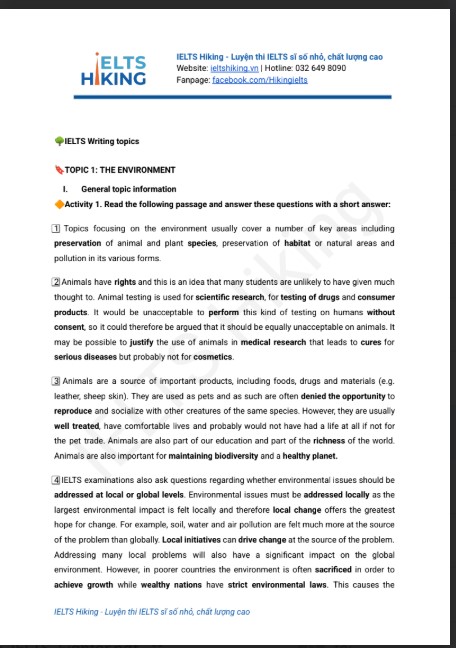
Topics focusing on the environment usually cover a number of key areas including preservation of animal and plant species, preservation of habitat or natural areas and pollution in its various forms.
Animals have rights and this is an idea that many students are unlikely to have given much thought to. Animal testing is used for scientific research, for testing of drugs and consumer products. It would be unacceptable to perform this kind of testing on humans without consent, so it could therefore be argued that it should be equally unacceptable on animals. It may be possible to justify the use of animals in medical research that leads to cures for serious diseases but probably not for cosmetics.
Animals are a source of important products, including foods, drugs and materials (e.g. leather, sheep skin). They are used as pets and as such are often denied the opportunity to reproduce and socialize with other creatures of the same species. However, they are usually well treated, have comfortable lives and probably would not have had a life at all if not for the pet trade. Animals are also part of our education and a part of the richness of the world. Animals are also important for maintaining biodiversity and a healthy planet.
IELTS examinations also ask questions regarding whether environmental issues should be addressed at local or global levels. Environmental issues must be addressed locally as the largest environmental impact is felt locally and therefore local change offers the greatest hope for change. For example, soil, water and air pollution are felt much more at the source of the problem than globally. Local initiatives can drive change at the source of the problem. Addressing many local problems will also have a significant impact on the global environment. However, in poorer countries the environment is often sacrificed in order to achieve growth while wealthy nations have strict environmental laws. This causes the
transfer of environmentally unfriendly production and associated environmental problems to poorer nations. The role of global environmental initiatives is to encourage countries to manage the local environment well in order to reduce overall pollution levels.
Excessive consumerism is another cause of environmental problems. Products that are designed to have short lives, have unnecessary packaging, are unnecessary or frivolous, and a lack of community sharing all contribute to environmental problems. Prices often do not accurately reflect the environmental cost of products. For this reason many nations are beginning to price carbon and companies are starting to be held accountable for environmental damage that they cause.
Nuclear Power is capable of producing large amounts of energy and in normal circumstances does not pollute the atmosphere. The risk with nuclear power is that there can be catastrophic failures such as Fukushima, Chernobyl and Three Mile Island. Although these failures are rare, they receive an enormous amount of attention and affect public opinion. It can be argued that many other forms of energy generation cause far more deaths and rarely receive public attention because they usually do not usually result in major news events. The number of deaths in polluted cities that arise from poor air quality is very high. Respiratory illness, lung diseases, and cancers are all significant problems. However, one of the major problems with nuclear energy is the storage of waste products. The half-life of nuclear waste is in the hundreds or thousands of years and it has to be stored carefully. Radioactive waste is usually buried but this is not without risks as pollutants can leach into water. The very long life of these products also means that over time there could be geological activity that exposes dangerous pollutants.
Water is essential to all life forms and must be managed carefully. Water conservation is becoming important for two key reasons – population growth and pollution. The problems with water are that it makes it moves and is therefore capable of transporting and dispersing pollution to other places. This makes it difficult to clean and pollution can build up over time. Problems include hormones in water (which can interfere with reproduction) and other chemicals that can damage environments such as oil and other toxic chemicals.
Noise pollution probably does not have a big impact on physical wellbeing but may impact emotional wellbeing. It is possible to separate the noises in people’s lives to those that are unavoidable such as from machinery and cars and sound that people choose to listen to as background noise such as, music or television. People are rarely in a low-noise environment. This may prevent people from having thinking time and affect their ability to relax. However, people’s brains are good at filtering out information that is distracting and background noise may prevent people from feeling lonely or isolated.
1. What key areas do the topic of the environment cover?
2. Is animal testing always justifiable?
3. Why are animals important?
4. What are some reasons for addressing environmental problems locally?
5. Why is the environment in less developed countries often more polluted than that in developed ones?
6. What are the benefits of dealing with environmental issues at an international level?
7. What are some characteristics of excessive consumerism?
8. What are the advantages and disadvantages of nuclear power?
9. Why is it difficult to make water sources clean?
10. What are the consequences of noise pollution?
IELTS Hiking – Luyện thi IELTS sĩ số nhỏ, chất lượng cao
Website: ieltshiking.vn | Hotline: 032 649 8090
Fanpage: facebook.com/Hikingielts
TOPIC 2: LAW
I. General topic information
Activity 1. Read the following passage and answer the questions that follow
A
Questions of law provide challenging problems as the role of the legal system is viewed differently in different cultures and this topic also has very complex vocabulary.
B
An important distinction between Western countries and developing countries is that in the power structure of Western countries, the law is above the government. For example, the supreme court in most countries has the power to overrule any law that is made if it violates the constitution (this occasionally occurs). In addition, any person can challenge any law and there is no requirement that the person who challenges a law is a citizen. In addition, the constitution can only be changed if approved directly by the people through a referendum.
C
The courts in most countries are broken into two separate areas, criminal and civil cases. In criminal cases (involving crimes) the case against the accused must be proved beyond “reasonable doubt” and there is a long appeals process. The key concept behind this is the principle that it is better to allow guilty people to go free than convict the innocent – this is different for many developing countries. Possible verdicts in criminal cases are “guilty” and “not-guilty” – “innocent” is not a verdict. The role of a court is to decide whether there is enough evidence to convict the accused, a jury may believe that a person probably committed a crime but that there is not enough evidence to be sure, and the verdict in such cases will be “not-guilty”. As a consequence of this philosophy, the percentage of not-guilty verdicts is much higher in Western countries compared to developing countries. When people are sent to jail, education and rehabilitation are important considerations because convicted criminals will usually later be freed back into the community.
D
Civil cases are related to money matters such as compensation and contract disputes and are decided on “the balance of probabilities” which means that all legal decisions in these cases are based on what the judge or jury believe to be the fairest or most likely outcome.
Any attempt at interference in the law is a very serious criminal offence, particularly if a person holding high office. For example, if a judge commits a minor traffic offence or other minor matter and signs an untrue statement he or she can expect to spend time in jail.
E
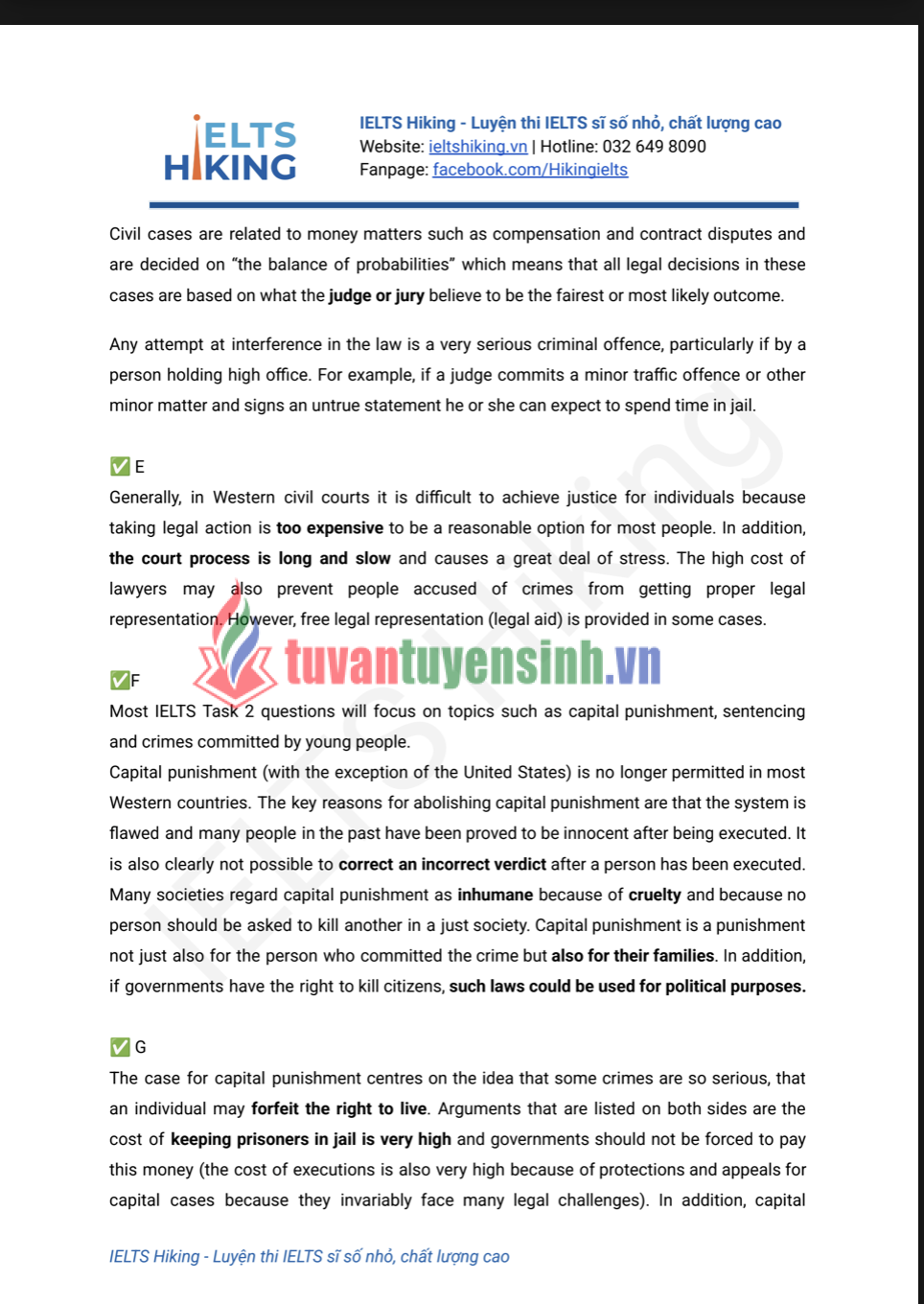
Generally, in Western civil courts it is difficult to achieve justice for individuals because taking legal action is too expensive to be a reasonable option for most people. In addition, the court process is long and slow and causes a great deal of stress. The high cost of lawyers may also prevent people accused of crimes from getting proper legal representation. However, free legal representation (legal aid) is provided in some cases.
F
Most IELTS Task 2 questions will focus on topics such as capital punishment, sentencing and crimes committed by young people.
Capital punishment (with the exception of the United States) is no longer permitted in most Western countries. The key reasons for abolishing capital punishment are that the system is flawed and many people in the past have been proved to be innocent after being executed. It is also clearly not possible to correct an incorrect verdict after a person has been executed. Many societies regard capital punishment as inhumane because of cruelty and because no person should be asked to kill another in a just society. Capital punishment is a punishment not just also for the person who committed the crime but also for their families. In addition, if governments have the right to kill citizens, such laws could be used for political purposes.
G
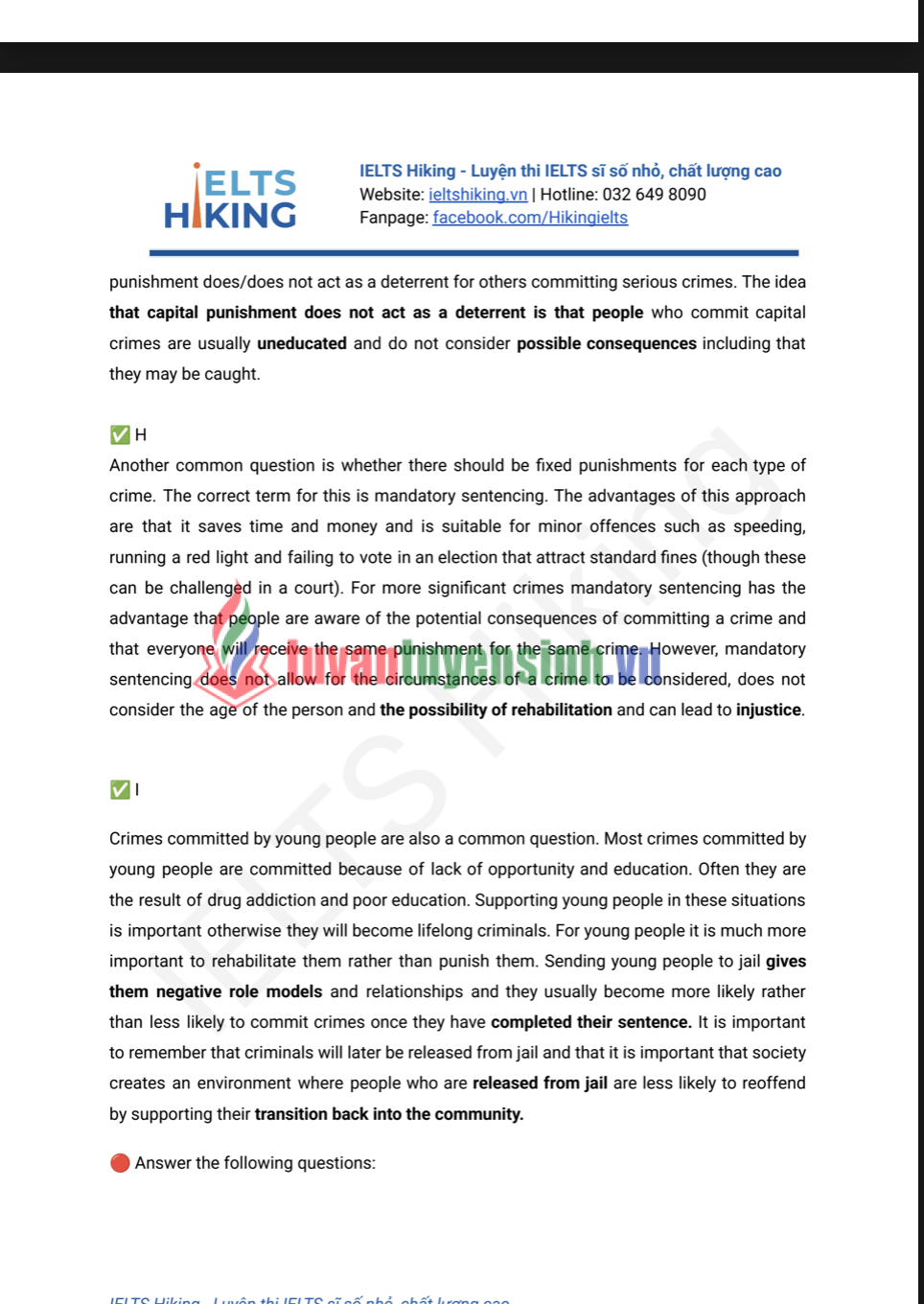
The case for capital punishment centres on the idea that some crimes are so serious, that an individual may forfeit the right to live. Arguments that are listed on both sides are the cost of keeping prisoners in jail is very high and governments should not be forced to pay this money (the cost of executions is also very high because of protections and appeals for capital cases because they invariably face many legal challenges). In addition, capital punishment does/does not act as a deterrent for others committing serious crimes. The idea that capital punishment does not act as a deterrent is that people who commit capital crimes are usually uneducated and do not consider possible consequences including that they may be caught.
H
Another common question is whether there should be fixed punishments for each type of crime. The correct term for this is mandatory sentencing. The advantages of this approach are that it saves time and money and is suitable for minor offences such as speeding, running a red light and failing to vote in an election that attract standard fines (though these can be challenged in a court). For more significant crimes mandatory sentencing has the advantage that people are aware of the potential consequences of committing a crime and that everyone will receive the same punishment for the same crime. However, mandatory sentencing does not allow for the circumstances of a crime to be considered, does not consider the age of the person and the possibility of rehabilitation and can lead to injustice.
I
Crimes committed by young people are also a common question. Most crimes committed by young people are committed because of lack of opportunity and education. Often they are the result of drug addiction and poor education. Supporting young people in these situations is important otherwise they will become lifelong criminals. For young people it is much more important to rehabilitate them rather than punish them. Sending young people to jail gives them negative role models and relationships and they usually become more likely rather than less likely to commit crimes once they have completed their sentence. It is important to remember that criminals will later be released from jail and that it is important that society creates an environment where people who are released from jail are less likely to reoffend by supporting their transition back into the community.