
The best preparation for IELTS Speaking
Young Kim
NTV công ty tnhh nhân trí việt
nhà xuất bản tổng hợp thành phố hồ chí minh
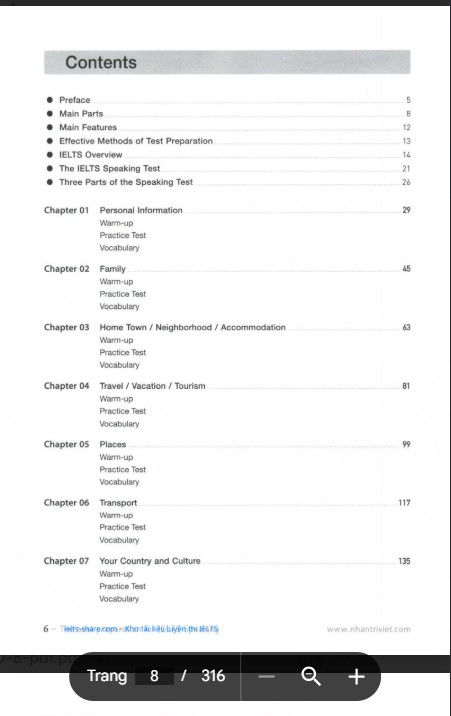
Contents
preface ………………………………………………………………………….. 5
main parts ……………………………………………………………………… 8
main features ………………………………………………………………….. 12
effective methods of test preparation ……………………………………… 13
ielts overview …………………………………………………………………… 14
the ielts speaking test ……………………………………………………….. 21
three parts of the speaking test …………………………………………… 26
chapter 01 personal information …………………………………………… 29
warm-up
practice test
vocabulary
chapter 02 family ………………………………………………………………… 45
warm-up
practice test
vocabulary
chapter 03 home town / neighborhood / accommodation ………………. 63
warm-up
practice test
vocabulary
chapter 04 travel / vacation / tourism ……………………………………. 81
warm-up
practice test
vocabulary
chapter 05 places ……………………………………………………………… 99
warm-up
practice test
vocabulary
chapter 06 transport ………………………………………………………….. 117
warm-up
practice test
vocabulary
chapter 07 your country and culture ……………………………………. 135
warm-up
practice test
vocabulary
chapter 08 communication ………………………………………………… 155
warm-up
practice test
vocabulary
chapter 09 people ……………………………………………………………. 171
warm-up
practice test
vocabulary
chapter 10 environment …………………………………………………… 189
warm-up
practice test
vocabulary
chapter 11 animals / pets ………………………………………………….. 207
warm-up
practice test
vocabulary
chapter 12 food ……………………………………………………………….. 225
warm-up
practice test
vocabulary
chapter 13 interest / hobby / free time ………………………………. 243
warm-up
practice test
vocabulary
chapter 14 sports / health …………………………………………………. 259
warm-up
practice test
vocabulary
chapter 15 tv / movies ……………………………………………………… 275
warm-up
practice test
vocabulary
answers ……………………………………………………………………….. 291
speak up – step 1 model answers
part 3 more questions & model answers
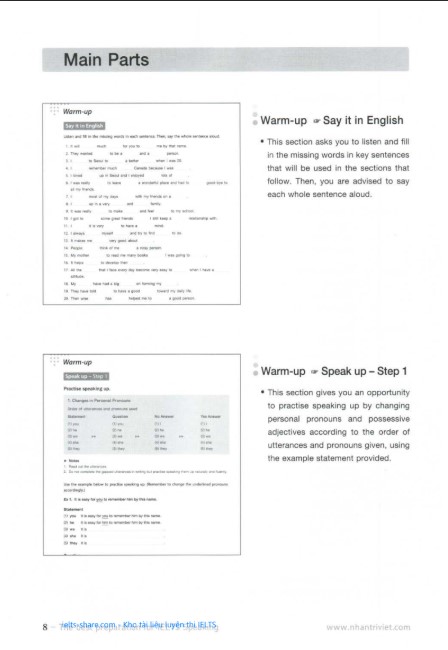
Main Parts
(Hình ảnh Warm-up – Say it in English)
Warm-up – say it in english
listen and fill in the missing words in each sentence. then, say the whole sentence aloud.
- it will much for you to are by their name.
- i worked a a father when i was 20.
- i lived in seoul and i moved to
- my friends to leave a secluded place and had to good-bye to
- i could with my friends at my
- my friends and family.
- it is always to make and feel to my school.
- i have many friends to keep a strong relationship with.
- it is very to have a mind.
- it makes me very good about
- i think of my person.
- my father to be an honest person i was going to
- it always my day becomes very easy to when i have a
- have had a big on turning my
- they have to have a good toward my daily life.
- then also has toward me to a good person.
Warm-up – say it in english
- this section asks you to listen and fill in the missing words in sections that will be used in the sections that follow. then, you are advised to say each whole sentence aloud.
(Hình ảnh Warm-up – Speak up – Step 1)
Warm-up – speak up – step 1
practice speaking up.
- changes in personal pronouns
order of utterances and pronouns used
statement question yes answer no answer - i like he he
- do you he yes he
- he is she he
- she has he he
- i am she he
- he has it he
- it is she he
- she has they he
- they are my they they
- we are your we we
- you are my you you
- i do they he
- she is he he
- he is she he
- he is he he
- they are we he
- we are he he
- you are i he
- i have she he
- he has he he
- notes
read out the utterances.
use the example letter to practice speaking up. remember to change the underlined pronouns accordingly.
do use the example letter to practice speaking up. remember to change the underlined pronouns accordingly.
statement it is easy for you to remember him by his name.
question is it easy for you to remember him by his name.
yes answer yes it is.
no answer no it is not.
statement my father is my hero.
question is your father your hero.
yes answer yes he is.
no answer no he is not.
Warm-up – speak up – step 1
- this section gives you an opportunity to practice speaking up by changing personal pronouns and possessive adjectives according to the order of utterances and pronouns given, using the example statement provided.
Warm-up – speak up – step 2
practice speaking up.
- changes in personal pronouns
order of utterances and pronouns used
statement question yes answer no answer - i like he he
- do you he yes he
- he is she he
- she has he he
- i am she he
- he has it he
- it is she he
- she has they he
- they are my they they
- we are your we we
- you are my you you
- i do they he
- she is he he
- he is she he
- he is he he
- they are we he
- we are he he
- you are i he
- i have she he
- he has he he
- no changes in personal pronouns
order of utterance question no answer yes answer - i like i i
- do you i yes i
- he is he yes he
- she has she yes she
- i am i yes i
- he has it yes it
- it is it yes it
- she has they yes they
- they are they yes they
- we are we yes we
- you are you yes you
- i do i yes i
- she is she yes she
- he is he yes he
- he is he yes he
- they are we yes we
- we are we yes we
- you are i yes i
- i have i yes i
- he has he yes he
- notes
- read out each statement.
- memorize it and do not turn it in again.
- use the sentences according to the order mentioned above, and then speak up your sentences naturally and fluently.
use the examples better to practice speaking up. (remember to follow the order mentioned above and change the underlined pronouns and possessive adjectives accordingly, if necessary.)
- it is easy for you to remember him by his name.
- my parents have always been a loving person.
- ho chi minh city is the best place to get a better job when i was 20 years old.
- i sometimes have a fantastic about them. it is true that one day they may have a…
Warm-up – speak up – step 2
- in this section, you will use the 20 statements given to practise speaking up by following the order mentioned and changing the underlined pronouns and possessive adjectives accordingly.
(Hình ảnh Practice Test – Part 1)
Practice Test – Part 1
question 1
what is your name?
personal answer
standard answer
my name is ly ly. my friends call me ly ly because i speak english well. please call me ly ly.
advanced answer
my surname is ly. my full name is ly ly. my friends call me ly ly because i speak english well and i want to be an english teacher in the future. so, please call me ly ly.
question 2
what does your name mean?
personal answer
Practice Test – Part 1
- five typical questions in part 1 of the ielts speaking test are given. you are asked to think of your personal answer to each of these questions and say it aloud.
- lower-level learners may look at standard answers, whereas higher-level ones may employ advanced answers as sample answers.
Practice Test – Part 2
Topic Card 2
describe your personality.
you should say:
what kind of person you think you are
what you family and friends think about your personality
is your personality special
and how your personality affects your life.
personal answer
standard answer
i think i am a very happy person. i have many friends and i always stay busy. my parents and my friends think i am a very outgoing person. i really enjoy meeting new people and i also like helping others. it makes me feel very good. my pen friend who lives in korea is a very interesting person, and that makes me very special. i think it is very important to have a healthy idea.
Practice Test – Part 2
- two typical topic-card questions in part 2 of the ielts speaking test are given. you are asked to think of your personal answer on the points listed for 1-2 minutes.
- lower-level learners may look at standard answers, whereas higher-level ones may employ advanced answers as sample answers.
Practice Test – Part 3
question 3
how do you like your personality?
suggested input
positive personality
genuine, charming, considerate, courageous, honest, generous, optimistic, organized, reasonable, understandable
negative personality
aggression, arrogant, bossy, cowardly, dishonest, irresponsible, pessimistic, fussy.
personal answer
model answer
Practice Test – Part 3
- five typical questions in part 3 of the ielts speaking test are given. you are asked to think of your personal answer to each of these questions and say it aloud.
- you may use the suggested input below each question in this part to prepare for your own answer.
- in addition to these five questions, more questions are provided for your further speaking practice.
Vocabulary
| Term | Related Words |
| nickname | coachman |
| be similar to | romantic |
| be composed of | respected |
| a to b | attitude |
| be raised | direct |
| capital | offend |
| headquarters | presume |
| convenient | impact |
| grow up | form |
| spring | functional |
| playground | share something in common |
| castle | complement |
| catch and seek | shape |
| rough | duty |
| transfer (n.) | trauma |
| transfer (v. for student) | most likely to |
| reliable | rare |
| outgoing | determine |
| homework | suitable |
| sociable | cooperate |
| think of a as b | cutting-edge |
Vocabulary
- this part lists vocabulary items that have previously been used in model answers either for your reference or meaning revision.
(Hình ảnh Answers – Chapter 1)
Answers
- at the end of the book, model answers to sections of speak up – step 1 and more questions are provided for your checking and further practice.
Main Features
each chapter of the book contains a number of particular topic-related questions so that they are not repeated or redundant.
(a) model answer(s) is/are always provided below each typical question in the three parts of the speaking test.
standard and advanced answers are separately provided, which facilitates learners’ application according to their levels.
in addition to every five typical questions presented, possible questions in part 3 of the ielts speaking test are supplied.
questions are grouped according to particular topics. learners, therefore, can easily select what they want to practise.
each chapter will begin with an overview of all the questions that will be presented in detail in the parts that follow. it will end with a list of vocabulary items that are previously used in the model answers.
learners may select any statements out of the 20 ones in the part say it in english to complete the gaps and then say the whole statements aloud to familiarise themselves with common english vocabulary and structures.
model statements together with cues for substitution drills in the speak up sections help learners to form language habits. these statements are also recorded for learners to check their drills.
more questions to part 3 enable learners to have more opportunities for further practice. most model answers to these questions are recorded for learners’ reference.
a. Listening
The Listening test is the same for both the Academic and General Training modules. It is in four sections with a total of 40 questions in order of increasing difficulty and will last about 30 minutes with an extra 10 minutes at the end for candidates to transfer their answers to the answer sheet.
In the Listening test, candidates will listen to four recorded texts in the form of monologues and conversations by a variety of voices and native-speaker accents. They then write their answers to a range of 40 questions which test the ability of understanding main ideas and detailed factual information, the opinions and attitudes of speakers, the purpose of what is said, and the ability of following the development of ideas.
b. Reading
In terms of reading, the Academic and General Training Reading tests are similar in many ways. The Reading test of both modules lasts one hour with three passages and a total of 40 questions and is scored in the same way. Noticeably, the main difference lies in the contents of the passages. In addition, candidates have to mark their answers while doing the test since they have no time to transfer their answers to the answer sheet as they can in the Listening test.
The Academic Reading test includes three long passages which range from the descriptive and factual to the discursive and analytical. All passages are authentic and taken from books, journals, newspapers, magazines, or research papers. These have been selected for a non-specialist audience but are recognisably appropriate for anyone entering undergraduate or postgraduate courses or seeking professional registration.
The General Training Reading test includes easier passages taken from books, magazines, newspapers, notices, advertisements, company handbooks, or guidelines. These are materials candidates are likely to encounter on a daily basis in an English-speaking environment.
c. Writing
The Writing test of both the Academic and General Training modules consists of two tasks, and candidates are given one hour to complete the test.
For the General Training Writing test, candidates have to complete two tasks of 150 words and 250 words respectively. Task 1 is always a letter, while Task 2, which is similar to that of the Academic module, is an essay based on a given title.
For the Academic Writing test, in Task 1, candidates are given a title based on some graphic or pictorial information, and they are expected to write a descriptive report of at least 150 words on the information provided. In Task 2, candidates are expected to produce an essay of at least 250 words on a given title whose topics are of general interest and to suitable for anyone entering undergraduate or postgraduate studies or seeking professional registration. Importantly, responses to both tasks must be written in a formal style.
www.ielts-share.com – Kho tài liệu luyện thi IELTS IELTS Overview – 15
d. Speaking
The Speaking test is the same for both the Academic and General Training modules and aims at assessing candidates’ use of spoken English. Every test is recorded and takes between 11 and 14 minutes to complete.
The Speaking test consists of three parts:
In Part 1, each candidate is asked to answer general questions about himself/herself and a range of familiar topics, such as home, family, work, studies, or interests. This part lasts between 4 and 5 minutes.
In Part 2, the candidate is given a card which asks him/her to talk about a particular topic. He/She will have one minute to prepare before speaking for up to two minutes. The examiner then asks him/her one or two follow-up questions on the same topic to finish this part of the test.
In Part 3, the examiner will ask the candidate further questions connected to the topic in Part 2. These questions give him/her an opportunity to discuss more abstract issues and ideas. This part lasts between four and five minutes.
Actually, the Speaking test is delivered in such a way that does not allow the candidate to rehearse set responses beforehand.
IELTS Registration
To register for an IELTS test, you can apply online, in person, or by post. To register online, you first have to check and select a test date, then register your personal details, and last pay by credit card.
If you register in person, you should follow these 5 simple steps:
- Contact the test centre you plan to sit the test to check the availability of the IELTS test dates of your choice. In Hanoi and Ho Chi Minh City, you can register at the British Council or IDP Australia.
- Complete an application form (obtained from the test centres in Hanoi and Ho Chi Minh City or downloaded from www.ielts.org).
- Provide two recent passport-sized photographs (taken within 6 months before the date of registration and remember that you must not wear glasses in your photographs).
- Provide a photocopy of your ID card/passport.
- Make payment in Vietnam Dong only.
You must complete each step in this process in order. Your IELTS registration will not be confirmed until you have finished all these 5 steps.
16 – ielts-share.com – Kho tài liệu luyện thi IELTS www.nhantriviet.com
If you want to register by post, you can apply by following the steps below:
- Contact the test centres to check the availability of the IELTS test dates of your choice.
- Download an application form.
- Fill out the application form.
- Enclose two passport-sized photos (taken within 6 months before the date of registration and remember that you must not wear glasses in your photographs).
- Enclose a photocopy of your ID card/passport (no notarization required).
- Send to the intended test centre. It is advisable that you use express services so as to avoid late delivery or your documents going missing.
If you want your results to be sent automatically to a university or an educational institution, you must point out this detail in the corresponding section on your IELTS application form.
Once you have registered, the test centre will confirm your IELTS test date, time, and venue. Also note that the Speaking test can be taken up to 7 days before or after the test date.
IELTS Results
Your results can be accessed online 13 days after the written test date (i.e. after 12 noon on the second Friday as of the test date if it was on a Saturday). You will need to enter your candidate number, passport or ID number, date of birth, and then select the date you took the test.
The original Test Report Form will be sent to you by post, unless you indicate on the form given to you on the test date that you would like to collect it in person. You can also authorise someone to collect the form, with a signed letter giving this person’s name and passport/ID number (the person must carry the mentioned ID), and a copy of your passport/ID.
Another original copy will be sent directly to the educational institution of your choice if you have specified this on your application form.
In actual fact, the IELTS test result is valid for 2 years. However, some universities or organisations may have their own regulations concerning the period of validity.
IELTS Band Scores
IELTS is a multi-level exam, so there is no pass or fail in the IELTS test. Candidates are graded on their performance, using a band score from 1 to 9 for each part of the test – Listening, Reading, Writing, and Speaking. The results from the four parts then produce an Overall Band Score. All parts of the test and the Overall Band Score can be reported in whole and half bands, e.g. 6.0, 6.5, 7.0, 7.5, etc. Most targeted universities often demand an IELTS score of 6.0 or 7.0. They may also demand a minimum score in each of the four parts. This unique 9-band system measures scores in a consistent manner – wherever and whenever the test is taken, i.e. it is internationally recognised.
www.ielts-share.com – Kho tài liệu luyện thi IELTS IELTS Overview – 17