

LỜI MỞ ĐẦU (Sách Tiếng Anh – Kỹ năng)
Kì thi tốt nghiệp THPT Quốc gia năm 2025 chỉ còn cách các sĩ tử hơn 5 tháng nữa thôi. 5 tháng cuối sẽ đầy thử thách, khó khăn nhưng ở đó cũng có sự tự hào, hạnh phúc, hành diện khi em trở thành Tân sinh viên ngôi trường đại học mơ ước. Cô Mai Phương tin rằng: 2007 là một thế hệ xuất sắc, bản lĩnh sẽ đủ khát khao, sự cố gắng để chinh phục giấc mơ lớn nhất tuổi 17 của mình.
“Dũng cảm nỗ lực học tập của em thật sự rất đẹp nên hãy tiếp tục cố gắng, nỗ lực nhé!”
Để giúp các em làm quen với đề, nâng cao kĩ năng giải và tích lũy vốn từ vựng, cấu trúc quen trọng có xin gửi tới các em tài liệu: 10 đề chuẩn cấu trúc đề minh họa năm 2025. Để việc luyện tập đạt hiệu quả tốt nhất các em nên:
- Bước 1: Bấm giờ tự thử sức với đề thi trong khóa học.
- Bước 2: Chấm điểm và xem coi mình đang sai, yếu thiếu ở phần kiến thức nào để kịp thời bổ sung cách học lại đơn vị kiến thức tương ứng.
- Bước 3: Xem kĩ phần hướng dẫn giải chi tiết tài liệu này của cô. Đặc biệt là những câu em làm sai. Học từ vựng, cấu trúc mà em chưa biết sau khi hoàn thành đề thi.
- Bước 4: Sau khi đã bổ sung kiến thức thì em thử sức lại 1-2 lần với đề.
Với các bài Đọc em áp dụng phương pháp 30-30-30.
Để đạt hiệu quả hơn để đoàn với các khóa học VIDEO/LIVESTREAM chứa; Cờ Flashcard từ vựng; tập dịch song ngữ kèm thêm khảo và các khóa học Luyện giải đề và tổng ôn giai đoạn cuối của cô nhé.
Tài liệu này bao gồm:
- Một đề thi mô phỏng Tiếng Anh năm 2025.
- 3 đề thi chắc điểm 8 môn Tiếng Anh.
- 6 đề thi chuẩn cấu trúc đề thi mô phỏng Tiếng Anh năm 2025.
Nhận dịp năm mới 2025 sắp đến cô Mai Phương xin chúc các em và gia đình thật nhiều sức khỏe, may mắn, thành công. Riêng với các sĩ tham dự kì thi năm 2025 sẽ đạt điểm số cao và Đỗ NV1 mơ ước.
“Thành công của chúng ta là dựa trên sự kiên trì chứ không phải dựa trên sự may mắn”
IELTS Fighter team luôn luôn thành công trên con đường chinh phục ngôn ngữ của mình!
Đặng Nguyệt Hà (Chủ biên)
MỤC LỤC (Kỹ năng IELTS – Ngữ pháp & Từ vựng)
| Chương/Mục | Nội dung | Trang |
| PHẦN I: 30 NGÀY ÔN NHANH TẤT TẦN TẬT NGỮ PHÁP | ||
| Chuyên đề 1: | Chinh Phục Ngữ Âm | 9 |
| Chuyên đề 2: | Tuyệt Chiêu Dùng Thạo 12 Thì Trong Tiếng Anh | 13 |
| Chuyên đề 3: | Nắm Chắc Các Động Từ Khuyết Thiếu Thường Gặp | 21 |
| Chuyên đề 4: | Chinh Phục Câu Điều Kiện Và Câu Ước | 26 |
| Chuyên đề 5: | Nhớ Kỹ Câu Bị Động | 29 |
| Chuyên đề 6: | Không Còn Lo Lằng Vì Câu Hỏi Đuôi | 34 |
| Chuyên đề 7: | Câu Giản Tiếp Không Hề Khó | 37 |
| Chuyên đề 8: | Khám Phá Danh Động Từ Và Động Từ Nguyên Mẫu | 41 |
| Chuyên đề 9: | Sự Hòa Hợp Giữa Chủ Ngữ Và Động Từ | 46 |
| Chuyên đề 10: | Mệnh Đề Quan Hệ Và Rút Gọn | 50 |
| Chuyên đề 11: | Nhận Biết Từ Loại | 55 |
| Chuyên đề 12: | Tính Từ Có Gì? | 59 |
| Chuyên đề 13: | Từ Hạn Định Và Đại Từ | 61 |
| Chuyên đề 14: | Kiến Thức Về Lượng Từ | 66 |
| Chuyên đề 15: | Cách Dùng Giới Từ Cần Biết | 68 |
| Chuyên đề 16: | Mở Khóa Câu So Sánh | 73 |
| Chuyên đề 17: | Mệnh Đề Trạng Ngữ | 77 |
| Chuyên đề 18: | Ước Đoán Trời Cháy Câu Chức Năng Giao Tiếp | 82 |
| PHẦN II: CÁC CHỦ ĐIỂM TỪ VỰNG CẦN THIẾT | 90 | |
| Chủ đề 1: School | 91 | |
| Chủ đề 2: Leisure Activities | 95 | |
| Chủ đề 3: City And Country Life | 99 | |
| Chủ đề 4: Places And Wonders | 102 | |
| Chủ đề 5: Environment | 105 | |
| Chủ đề 6: Health | 109 | |
| Chủ đề 7: Community Service | 112 | |
| Chủ đề 8: Music And Arts | 115 | |
| Chủ đề 9: Food And Drinks | 119 | |
| Chủ đề 10: Traffic | 122 | |
| Chủ đề 11: Customs And Traditions | 125 | |
| Chủ đề 12: Festival And Holiday | 128 | |
| Chủ đề 13: The Media | 132 | |
| Chủ đề 14: Tourism | 135 | |
| Chủ đề 15: Other Planets | 138 | |
| Chủ đề 16: Energy | 141 | |
| Chủ đề 17: Science And Technology | 144 | |
| Chủ đề 18: Changing Roles In Society | 147 | |
| Chủ đề 19: Cụm Động Từ (Phrasal Verb) | 151 | |
| Chủ đề 20: Idioms and Collocations | 164 | |
| B. ĐÁP ÁN VÀ HƯỚNG DẪN GIẢI | 173 | |
| PHẦN III: CHUYÊN ĐỀ LUYỆN THI | 197 | |
| A. LUYỆN TẬP | 198 | |
| Chuyên đề 1: | 50 Câu Luyện Dạng Hoàn Thành Câu | 198 |
| Chuyên đề 2: | 50 Câu Luyện Dạng Tìm Lỗi Sai | 201 |
| Chuyên đề 3: | 50 Câu Luyện Dạng Từ Đồng Nghĩa Và Từ Trái Nghĩa | 205 |
| Chuyên đề 4: | 50 Câu Luyện Dạng Chia Động Từ | 211 |
| Chuyên đề 5: | 10 Bài Luyện Dạng Hoàn Thành Đoạn Văn | 214 |
| Chuyên đề 6: | 10 Bài Luyện Đọc Hiểu – Trả Lời Câu Hỏi | 219 |
| Chuyên đề 7: | 50 Câu Luyện Dạng Viết Lại Câu | 228 |
| Chuyên đề 8: | 10 Bài Luyện Viết Đoạn Văn Hoặc Email | 236 |
| B. ĐÁP ÁN VÀ HƯỚNG DẪN GIẢI | 243 | |
| PHẦN IV: CÁC ĐỀ THI THỬ SÁT NHẤT CẤU TRÚC ĐỀ THI THẬT | ||
| A. ĐỀ THI SÁT CẤU TRÚC ĐỀ HÀ NỘI, YÊN BÁI, VĨNH LONG, NINH BÌNH | 276 | |
| B. ĐỀ THI HOÀN 10 BÁM SÁT CẤU TRÚC CỦA MỘT SỐ TỈNH/ THÀNH PHỐ KHÁC | 277 | |
| PHẦN V: MẸO VÀ BÍ KÍP LÀM BÀI TẬP | 280 | |
| A. MẸO, BÍ KÍP VÀ KINH NGHIỆM CHỌN ĐÁP ÁN TRẮC NGHIỆM | 281 | |
| B. SKIMMING & SCANNING – BÍ KÍP HÓA GIẢI MỌI BÀI ĐỌC HIỂU | 284 |
TOPIC LIST
Dưới đây là danh sách chủ đề xuất hiện trong sách. Các bài nghe trong sách đều được phân loại theo từng chủ đề từng chủ đề.
Các nội dung được biên soạn sách thể hiện xu hướng ra đề mới nhất trong kỳ thi thực. Nếu bám sát lộ trình và các nội dung này, người học có thể nắm rõ những chủ đề thường xuyên xuất hiện trong bài thi và biết được những điểm yếu cần khắc phục của bản thân. Từ đó, người học sẽ có chiến lược học tập phù hợp như: chọn ra những chủ đề mà bản thân còn yếu, giải lại đề và ghi nhớ từ vựng thuộc chủ đề đó.
| SECTION | Topics |
| SECTION 1 | Facility: DT 1-10, Ch HP 5-8, Ch 2 HT 1-10 |
| School life: Ch 3 HP 1-4 | |
| Destination: DT 11-20, Ch 6 HP 1-4, Ch 6 HT 1-10 | |
| SECTION 2 | Infrastructure: Ch 1 HT 1-10, Ch 2 HP 10-13, Ch 6 HP 8-11 |
| Event: Ch 4 HP 1-4, Ch 7 HP 4-7 | |
| Instruction: Ch 1 HP 5-7 | |
| Other topics: Ch 5 HP 1-3, Ch 6 HP 12-14 | |
| SECTION 3 | Anthropology – Archaeology: Ch 7 HP 12-15, Ch 7 HT 1-10 |
| Biology: Ch 4 HP 9-13, Ch 5 HT 1-10 | |
| Business: Ch 1 HT 11-20, Ch 3 HP 9-13 | |
| Education: Ch 4 HP 5-8 | |
| Engineering: Ch 1 HP 17-20 | |
| Theatre: Ch 7 HP 8-11 | |
| Geology: AT 21-30 | |
| Linguistics: Ch 4 HP 14-17, Ch 5 HP 8-12 | |
| Psychology: DT 21-30, Ch 1 HP 12-16 | |
| Biology: Ch 5 HP 13-17, AT 31-40 | |
| Business: Ch 4 HT 1-10 | |
| Chemistry: Ch 2 HT 11-20 | |
| Food – Nutrition: Ch 1 HP 21-25, Ch 3 HT 1-10 | |
| SECTION 4 | History: DT 31-40 |
| Geology: Ch 4 HP 16-21 | |
| Medical science: Ch 2 HP 19-22 | |
| Psychology: Ch 2 HP 23-28 | |
| Technology: Ch 4 HP 22-25 |
(Ghi chú: DT: Diagnostic Test, HP: Hackers Practice, HT: Hackers Test, AT: Actual Test)
PRO3M & PRO 3MPLUS: HỌC TRỌNG TÂM – HỌC ĐÚNG – HỌC TRÚNG
Theo dõi Fanpage : Học Tiếng Anh cùng cô Vũ Mai Phương để học GIỎI TIẾNG ANH HƠN mỗi ngày cùng cô.
Question 20.
A. She has been designed to assist humans in healthcare, customer support, and education
B. People in the fields of healthcare, customer service, and education helped create Sophia
C. Intending to aid humans in healthcare, customer support, and education, Sophia was developed
D. The assistance in customer support, education, and healthcare led to the creation of Sophia
Question 21.
A. Without cameras and microphones working as her eyes and ears, she could hear and see like humans
B. Her eyes and ears work as cameras and microphones so that people can see and hear her
C. She has cameras for eyes and microphones for ears, allowing her to see and hear like a human
D. Using cameras and microphones for eyes and ears, they allow her to see and hear as humans do
Question 22.
A. Sophia can understand human speech and interact with people
B. human speech and interaction are becoming so easy to Sophia
C. the machine can help Sophia speak and interact with humans
D. interaction in speech between Sophia and humans takes place
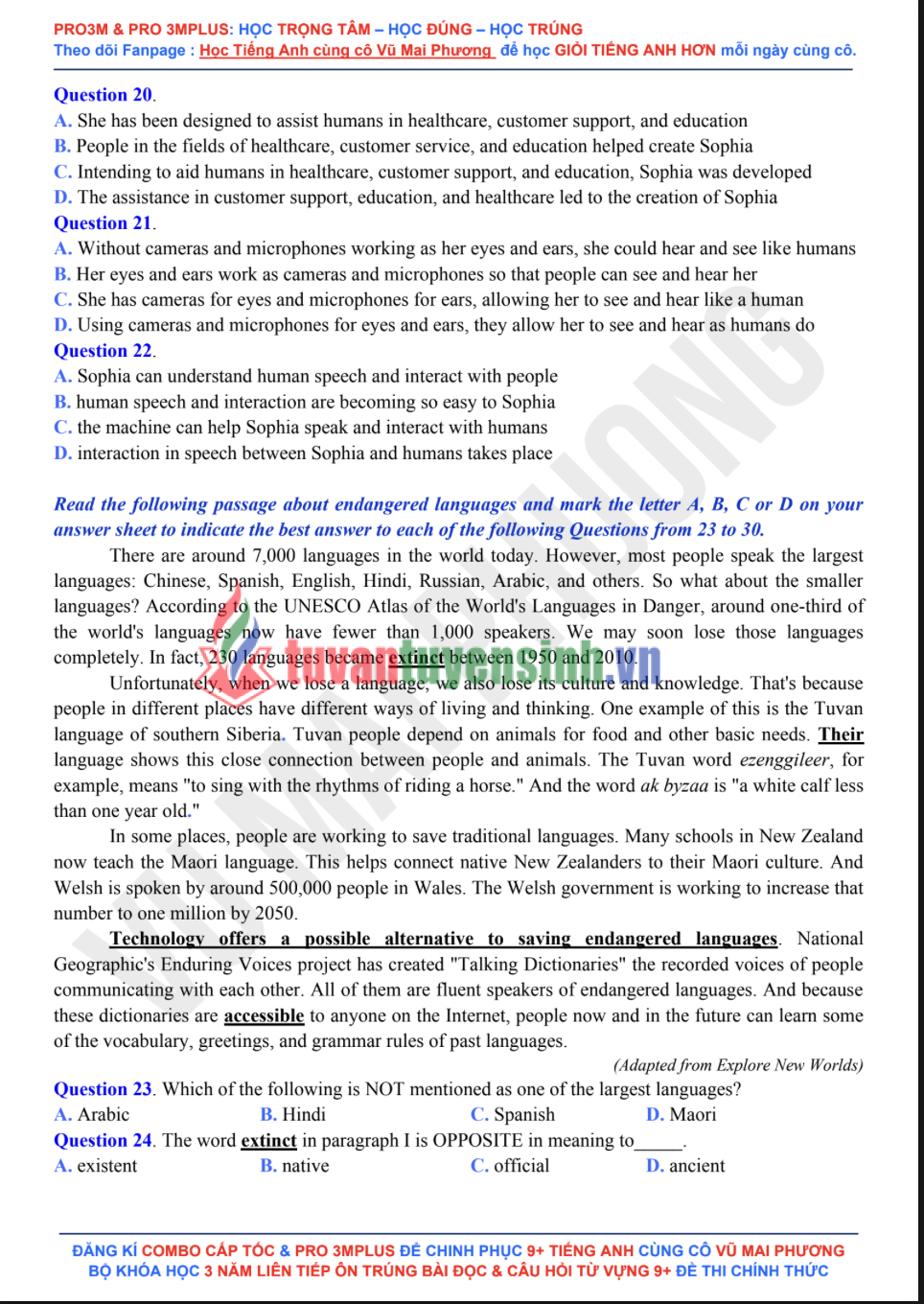
Read the following passage about endangered languages and mark the letter A, B, C or D on your answer sheet to indicate the best answer to each of the following Questions from 23 to 30.
There are around 7,000 languages in the world today. However, most people speak the largest languages: Chinese, Spanish, English, Hindi, Russian, Arabic, and others. So what about the smaller languages? According to the UNESCO Atlas of the World’s Languages in Danger, around one-third of the world’s languages now have fewer than 1,000 speakers. We may soon lose those languages completely. In fact, 230 languages became extinct between 1950 and 2010.
Unfortunately, when we lose a language, we also lose its culture and knowledge. That’s because people in different places have different ways of living and thinking. One example of this is the Tuvan language of southern Siberia. Tuvan people depend on animals for food and other basic needs. Their language shows this close connection between people and animals. The Tuvan word ezenggileer, for example, means “to sing with the rhythms of riding a horse.” And the word ak byzaa is “a white calf less than one year old.”
In some places, people are working to save traditional languages. Many schools in New Zealand now teach the Maori language. This helps connect native New Zealanders to their Maori culture. And Welsh is spoken by around 500,000 people in Wales. The Welsh government is working to increase that number to one million by 2050.
Technology offers a possible alternative to saving endangered languages. National Geographic’s Enduring Voices project has created “Talking Dictionaries” the recorded voices of people communicating with each other. All of them are fluent speakers of endangered languages. And because these dictionaries are accessible to anyone on the Internet, people now and in the future can learn some of the vocabulary, greetings, and grammar rules of past languages.
(Adapted from Explore New Worlds)
Question 23. Which of the following is NOT mentioned as one of the largest languages?
A. Arabic B. Hindi C. Spanish D. Maori
Question 24. The word extinct in paragraph I is OPPOSITE in meaning to ______.
A. existent B. native C. official D. ancient
PRO3M & PRO 3MPLUS: HỌC TRỌNG TÂM – HỌC ĐÚNG – HỌC TRÚNG
Theo dõi Fanpage : Học Tiếng Anh cùng cô Vũ Mai Phương để học GIỎI TIẾNG ANH HƠN mỗi ngày cùng cô.
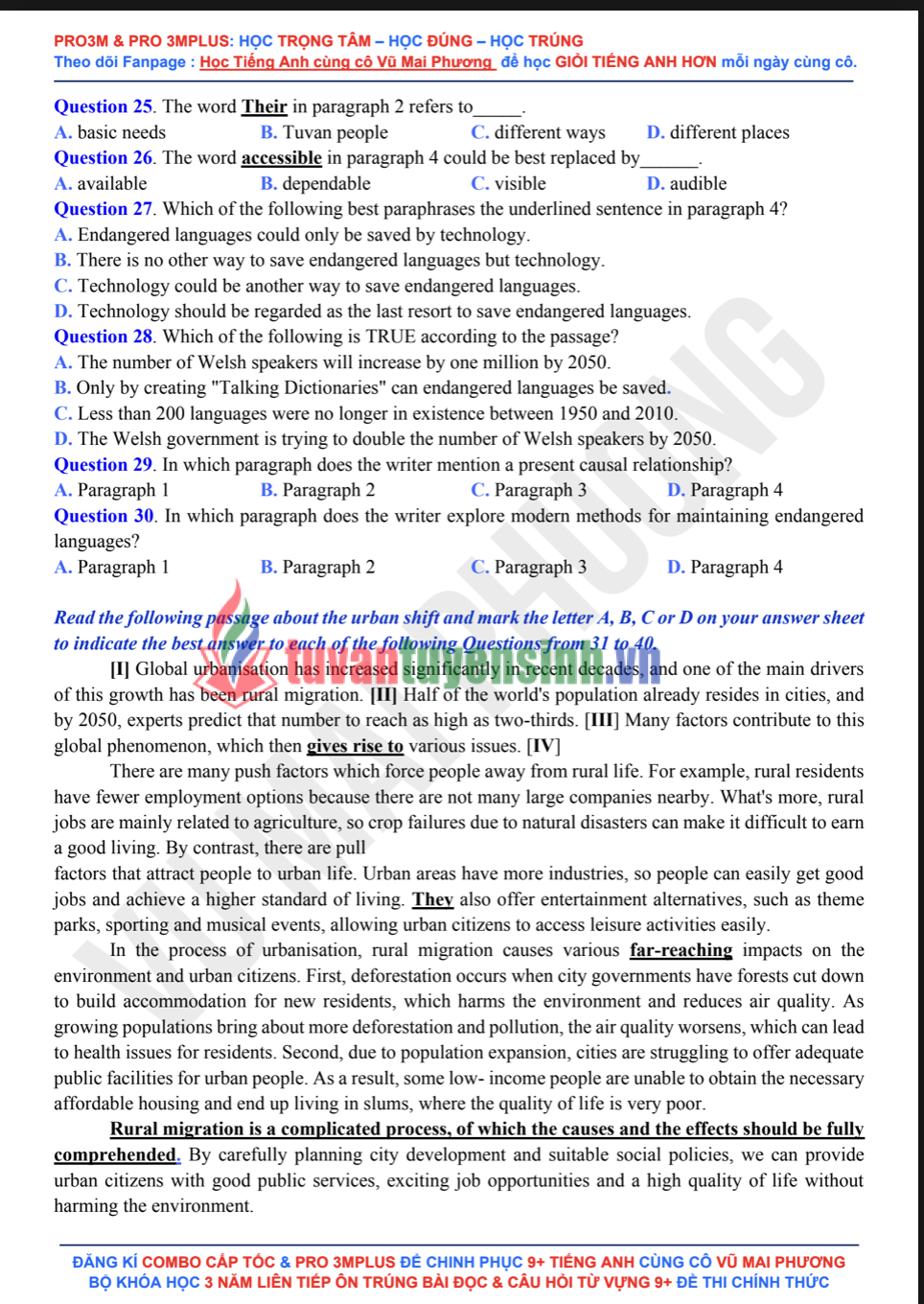
Question 25. The word Their in paragraph 2 refers to .
A. basic needs B. Tuvan people C. different ways D. different places
Question 26. The word accessible in paragraph 4 could be best replaced by.
A. available B. dependable C. visible D. audible
Question 27. Which of the following best paraphrases the underlined sentence in paragraph 4?
A. Endangered languages could only be saved by technology.
B. There is no other way to save endangered languages but technology.
C. Technology could be another way to save endangered languages.
D. Technology should be regarded as the last resort to save endangered languages.
Question 28. Which of the following is TRUE according to the passage?
A. The number of Welsh speakers will increase by one million by 2050.
B. Only by creating “Talking Dictionaries” can endangered languages be saved.
C. Less than 200 languages were no longer in existence between 1950 and 2010.
D. The Welsh government is trying to double the number of Welsh speakers by 2050.
Question 29. In which paragraph does the writer mention a present causal relationship?
A. Paragraph 1 B. Paragraph 2 C. Paragraph 3 D. Paragraph 4
Question 30. In which paragraph does the writer explore modern methods for maintaining endangered languages?
A. Paragraph 1 B. Paragraph 2 C. Paragraph 3 D. Paragraph 4
Read the following passage about the urban shift and mark the letter A, B, C or D on your answer sheet to indicate the best answer to each of the following Questions from 31 to 40.
[I] Global urbanisation has increased significantly in recent decades, and one of the main drivers of this growth has been rural migration. [II] Half of the world’s population already resides in cities, and by 2050, experts predict that number to reach as high as two-thirds. [III] Many factors contribute to this global phenomenon, which then gives rise to various issues. [IV]
There are many push factors which force people away from rural life. For example, rural residents have fewer employment options because there are not many large companies nearby. What’s more, rural jobs are mainly related to agriculture, so crop failures due to natural disasters can make it difficult to earn a good living. By contrast, there are pull factors that attract people to urban life. Urban areas have more industries, so people can easily get good jobs and achieve a higher standard of living. They also offer entertainment alternatives, such as theme parks, sporting and musical events, allowing urban citizens to access leisure activities easily.
In the process of urbanisation, rural migration causes various far-reaching impacts on the environment and urban citizens. First, deforestation occurs when city governments have forests cut down to build accommodation for new residents, which harms the environment and reduces air quality. As growing populations bring about more deforestation and pollution, the air quality worsens, which can lead to health issues for residents. Second, due to population expansion, cities are struggling to offer adequate public facilities for urban people. As a result, some low-income people are unable to obtain the necessary affordable housing and end up living in slums, where the quality of life is very poor.
Rural migration is a complicated process, of which the causes and the effects should be fully comprehended. By carefully planning city development and suitable social policies, we can provide urban citizens with good public services, exciting job opportunities and a high quality of life without harming the environment.
(Adapted from Bright)
ĐĂNG KÍ COMBO CẤP TỐC & PRO 3MPLUS ĐỂ CHINH PHỤC 9+ TIẾNG ANH CÙNG CÔ VŨ MAI PHƯƠNG
BỘ KHÓA HỌC 3 NĂM LIÊN TIẾP ÔN TRÚNG BÀI ĐỌC & CÂU HỎI TỪ VỰNG 9+ ĐỀ THI CHÍNH THỨC
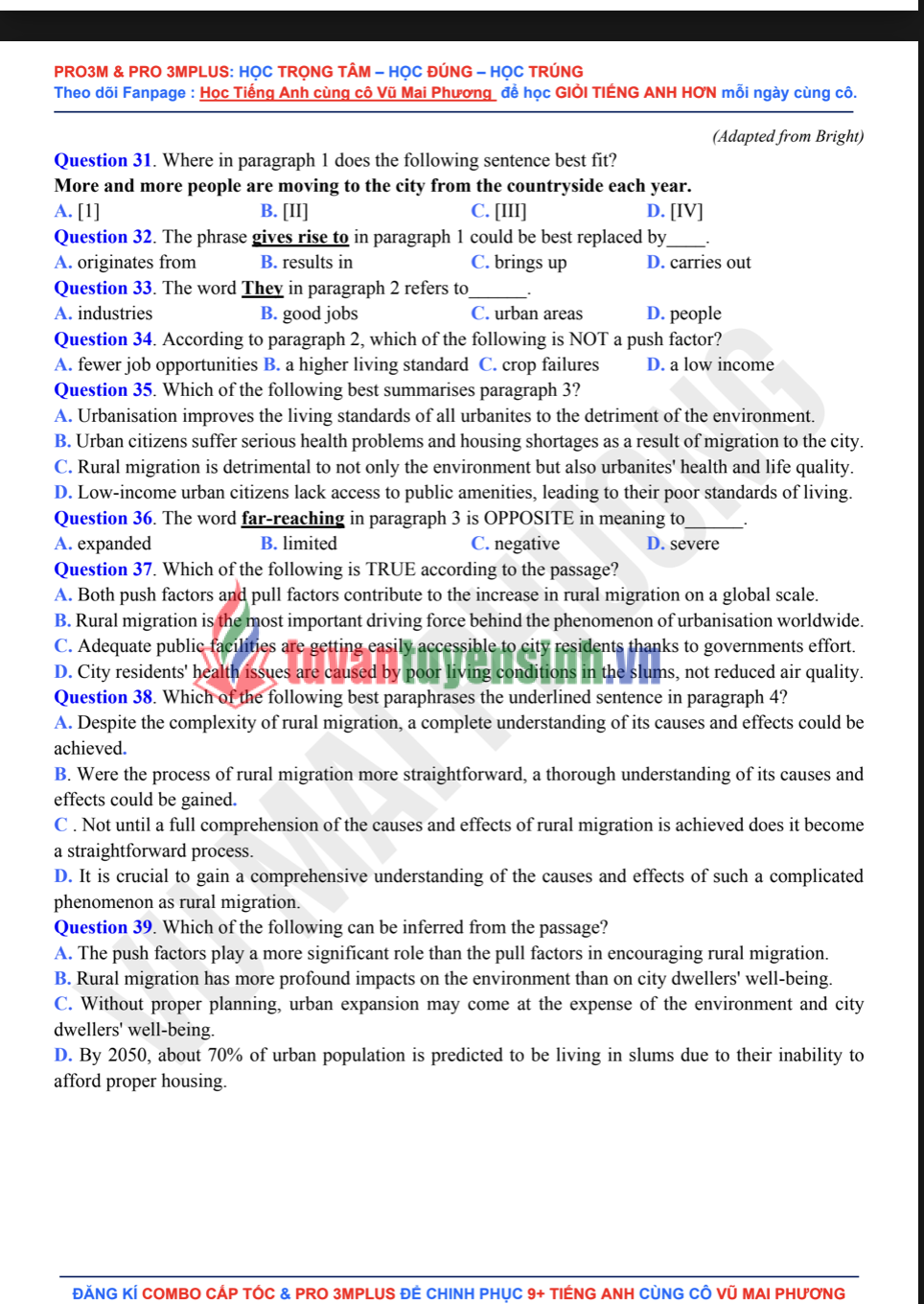
Question 31. Where in paragraph 1 does the following sentence best fit?
More and more people are moving to the city from the countryside each year.
A. [1] B. [II] C. [III] D. [IV]
Question 32. The phrase gives rise to in paragraph 1 could be best replaced by______.
A. originates from B. results in C. brings up D. carries out
Question 33. The word They in paragraph 2 refers to______.
A. industries B. good jobs C. urban areas D. people
Question 34. According to paragraph 2, which of the following is NOT a push factor?
A. fewer job opportunities B. a higher living standard C. crop failures D. a low income
Question 35. Which of the following best summarises paragraph 3?
A. Urbanisation improves the living standards of all urbanites to the detriment of the environment.
B. Urban citizens suffer serious health problems and housing shortages as a result of migration to the city.
C. Rural migration is detrimental to not only the environment but also urbanites’ health and life quality.
D. Low-income urban citizens lack access to public amenities, leading to their poor standards of living.
Question 36. The word far-reaching in paragraph 3 is OPPOSITE in meaning to______.
A. expanded B. limited C. negative D. severe
Question 37. Which of the following is TRUE according to the passage?
A. Both push factors and pull factors contribute to the increase in rural migration on a global scale.
B. Rural migration is the most important driving force behind the phenomenon of urbanisation worldwide.
C. Adequate public facilities are getting easily accessible to city residents thanks to governments effort.
D. City residents’ health issues are caused by poor living conditions in the slums, not reduced air quality.
Question 38. Which of the following best paraphrases the underlined sentence in paragraph 4?
A. Despite the complexity of rural migration, a complete understanding of its causes and effects could be achieved.
B. Were the process of rural migration more straightforward, a thorough understanding of its causes and effects could be gained.
C. Not until a full comprehension of the causes and effects of rural migration is achieved does it become a straightforward process.
D. It is crucial to gain a comprehensive understanding of the causes and effects of such a complicated phenomenon as rural migration.
Question 39. Which of the following can be inferred from the passage?
A. The push factors play a more significant role than the pull factors in encouraging rural migration.
B. Rural migration has more profound impacts on the environment than on city dwellers’ well-being.
C. Without proper planning, urban expansion may come at the expense of the environment and city dwellers’ well-being.
D. By 2050, about 70% of urban population is predicted to be living in slums due to their inability to afford proper housing.
ĐĂNG KÍ COMBO CẤP TỐC & PRO 3MPLUS ĐỂ CHINH PHỤC 9+ TIẾNG ANH CÙNG CÔ VŨ MAI PHƯƠNG
BỘ KHÓA HỌC 3 NĂM LIÊN TIẾP ÔN TRÚNG BÀI ĐỌC & CÂU HỎI TỪ VỰNG 9+ ĐỀ THI CHÍNH THỨC