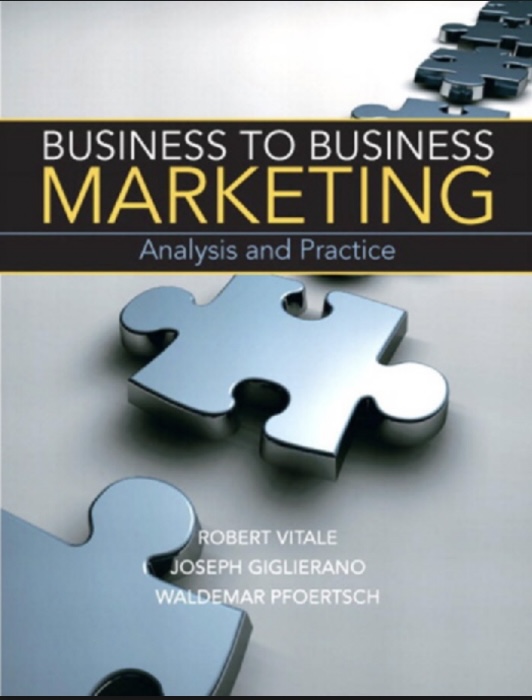
Business To Business Marketing: Phân Tích Và Thực Hành Chiến Lược B2B (PDF Tải Miễn Phí)

Sách Business To Business Marketing PDF Tải Miễn Phí Phân Tích Và Thực Hành Chiến Lược B2B (PDF Tải Miễn Phí)

Sách Business To Business Marketing PDF Tải Miễn Phí Phân Tích Và Thực Hành Chiến Lược B2B (PDF Tải Miễn Phí) là một trong những đáng đọc và tham khảo. Hiện Sách Business To Business Marketing PDF Tải Miễn Phí Phân Tích Và Thực Hành Chiến Lược B2B (PDF Tải Miễn Phí) đang được Tư Vấn Tuyển Sinh chia sẻ miễn phí dưới dạng file PDF.

=> Bạn chỉ cần nhấn vào nút “Tải tài liệu” ở phía bên dưới là đã có thể tải được về máy của mình rồi.

Lưu ý quan trọng

Bên dưới đây mình có spoil 1 phần nội dung trong tài liệu để bạn tham khảo trước về nội dung tài liệu / Sách. Để xem được full nội dung thì bạn hãy nhấn vào nút “Link tải PDF” ở trên để tải bản đầy đủ về nhé

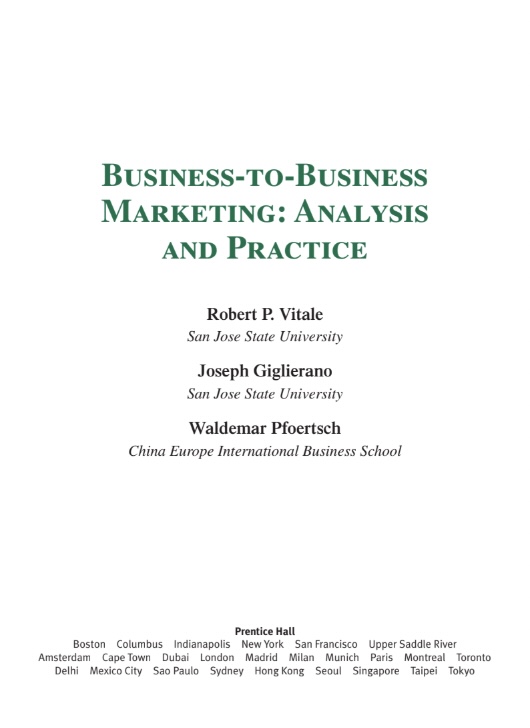
Trong thế giới kinh doanh hiện đại, Marketing B2B (Business-to-Business) ngày càng đóng vai trò quan trọng trong việc kết nối doanh nghiệp với doanh nghiệp, tối ưu hóa giá trị chuỗi cung ứng và tạo lợi thế cạnh tranh bền vững. Cuốn sách “Business to Business Marketing: Analysis and Practice” của Robert Vitale, Joseph Giglierano và Waldemar Pfoertsch là một tài liệu toàn diện, cung cấp cả cơ sở lý thuyết và ứng dụng thực tế cho các nhà quản trị, marketer và sinh viên chuyên ngành.
Nội dung nổi bật của sách

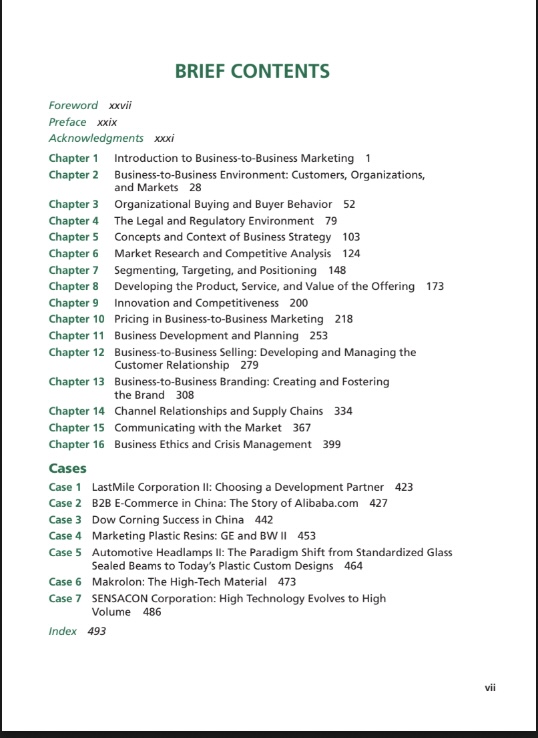
  • Phân tích môi trường B2B: Tập trung vào khách hàng, tổ chức và thị trường doanh nghiệp.
  • Hành vi mua hàng tổ chức: Hiểu rõ cách doanh nghiệp ra quyết định và các yếu tố ảnh hưởng.
  • Chiến lược và định vị: Bao gồm nghiên cứu thị trường, phân khúc, định vị và xây dựng chiến lược cạnh tranh.
  • Quản trị quan hệ khách hàng (CRM): Hướng dẫn cách phát triển và duy trì mối quan hệ lâu dài với khách hàng B2B.
  • Thương hiệu trong B2B: Tạo dựng, duy trì và phát triển thương hiệu doanh nghiệp.
  • Giá cả và kênh phân phối: Cách thiết lập chính sách giá phù hợp và quản lý kênh phân phối hiệu quả.
  • Truyền thông và bán hàng B2B: Tối ưu hóa các kênh giao tiếp, kết hợp truyền thông số và truyền thống.
  • Đạo đức kinh doanh và quản trị khủng hoảng: Những vấn đề cấp thiết trong bối cảnh toàn cầu hóa.

Điểm đặc biệt: Các Case Study thực tiễn

  • Alibaba tại Trung Quốc: Câu chuyện thương mại điện tử B2B đột phá.
  • Dow Corning, GE, BWI: Các ví dụ điển hình về quản trị sản phẩm và đổi mới công nghệ.
  • Makrolon & Sensacon: Ứng dụng công nghệ cao trong chuỗi cung ứng B2B.

Lợi ích khi đọc cuốn sách này

  • Doanh nghiệp B2B: Có thêm công cụ để thiết lập chiến lược marketing hiệu quả.
  • Marketer & Sinh viên: Nắm rõ lý thuyết nền tảng kết hợp tình huống thực tế.
  • Nhà quản trị cấp cao: Hiểu rõ hành vi tổ chức, từ đó ra quyết định kinh doanh chính xác hơn.

FOREWORDIn recent years, the importance of marketing in the business-to-business sector has grown. Many companies operate now in a more volatile and changing market and have to deal with fierce competition in an increasingly global market. To remain viable and competitive, business-to-business marketers are increasingly adopting marketing strategies that go beyond previous “price and ship” tactics.Business-to-Business Marketing: Analysis and Practice provides a learning platform for the next generation of managers in industrial companies. In this practitioner oriented and international B2B marketing textbook, managers can find concepts and examples that help to take a more analytical and disciplined approach to sales and marketing of industrial goods.While all companies claim to deliver superior value, companies particularly serving business-to-business (B2B) markets must be able to prove such claims. In the increasingly global world, it is more important than ever to be able to demonstrate in an objective and data-driven fashion that products, platforms, systems, and services will yield economic benefit to customers, collaborators, and stakeholders. Companies can deliver this value creation either by reducing costs or by providing broad-based, solution-oriented offerings. Industrial conglomerates, as well as small and medium-sized B2B companies, are constantly being challenged, and it is now not enough to offer “the most scalable, reliable, secure solution available today.”Many companies, from heavy construction equipment to microprocessor chips, have moved from technology-assisted selling concepts to marketing concepts offering proven value to their customers and business partners. The stakes are high and the need for professional knowledge and advice is predominant. The structured approach and up-to-date case studies of Business-to-Business Marketing: Analysis and Practice will fulfill the need for more in-depth understanding of marketing in the twenty-first century. This book explains situations, effects, and trends and also presents concepts, frameworks, and models in a very comprehensive way. It offers, for students and professionals alike, an easy way of learning what is needed to be marketers in the current B2B environment.The art and science of marketing has evolved well beyond early concepts. The differences between business-to-business markets and consumer markets have grown such that many generalizations of one market are not applicable to the other. Yet, the basic precepts, the product life cycle, the marketing mix and the promotion mix, to name a few, still apply. Concepts of customer value, market ownership, and total offering management add new dimensions to business-to-business marketing. When these ideas are integrated and combined, they provide a richness and depth to market understanding. However, this integration has not always come about in a way that is manageable for students. This textbook, Business-to-Business Marketing, starts with a basic review of concepts and then differentiates the differences between business and consumer markets. In a down-to-earth fashion, these basics are then integrated in a way that each supports the other, providing an anchor for the student.The combined experiences of the authors, Vitale, Giglierano, and Pfoertsch, represent expertise from academics, consulting, public agencies, and large and small industries, as both customers and marketers. They deliver an approach that is understandable yet comprehensive, logical yet enlightening, to both students and professionals of business-to-business marketing. Real companies in real situations, combined with believable academic exercises, demonstrate the experience and depth of the authors. Their effort provides an opportunity to understand thexxvii


PREFACEWhen we began our first business-to-business book, Business to Business Marketing: Analysis and Practice in a Dynamic Environment, the “parent” edition of this textbook, we felt that our perspectives as business-to-business practitioners, consultants, and academics over many years and with different industries, from the high-tech firms of Silicon Valley to the “old economy” of the automotive industry, created a foundation to develop a text that reflected our experiences while also being understandable to students whose preparation might be limited to an introductory course in marketing (and of course experience as consumers!). We emphasized the dynamic realities of the marketplace while reinforcing the most important principles that one will need to be effective, competent professionals in the real world. Based on feedback from many adopters around the world, we succeeded in many ways. Additionally, our continuing effort to improve both our research in the field and through classroom testing of concepts led us to understand the areas where we could make improvements.One of the additions to this textbook is Waldemar Pfoertsch, originally from Pforzheim University in Germany, now at CEIBS Shanghai (China Europe International Business School). Waldemar, as an international adopter of our book, provided heartening feedback and critical suggestions. Waldemar was so enthusiastic about our efforts that he came to California to meet with us. Waldemar’s book with Philip Kotler, B2B Brand Management, was new, and his work in brand management was an excellent verification of the brand concepts we espoused. His contributions include the new Chapter 13, as well as classroom-tested case studies.Several principles that guided the development of our previous book continue here. Porter’s Value Chain provides the underpinning for the Marketing Concept, and its application and implementation. The Product Life Cycle and Moore’s Technology Adoption Life Cycle form the basis for considering the dynamics of market evolution. Hamel and Prahalad’s ideas on business strategy and Dickson’s thoughts on competitive market behavior form the basis for our discussion of marketing strategy formulation. The Societal Marketing Concept is a key element of ethical marketing behavior. In each of these areas, we build on common threads that hold the whole together.Each chapter benefits from observations made in real-world situations. We rely again on our academic and consulting research to contribute ideas and examples in each chapter as well. Each chapter benefits from the multiple dialogues we have conducted with executives and managers since we began work on this project. Of particular note is the addition of Chapter 11, focused on Business Development. Forecasting has been shifted from Chapter 6 into this new Chapter 11, acknowledging its importance to business development efforts and based on the feedback that Chapter 6 in our first effort was overcrowded.Other changes in response to feedback include the expansion of Chapters 4 and 16 (originally Chapter 14). During the review of our original edition, adopters had mixed opinions about the need for a separate chapter on the legal environment and our business ethics approach as well. We believe these to be critical issues too often overlooked in business marketing and included the chapters anyway. Preliminary reviews for this book demonstrated significantly increased interest in these topics. In response, a discussion of Sarbanes–Oxley and its global offspring and the Foreign Corrupt Practices Act have been added. Licensing, cross-licensing, and joint ventures, which are often key to the concept of Value Networks, are also discussed. Chapter 16, “Business Ethics and Crisis Management,” gives increased coverage of crisisxxix


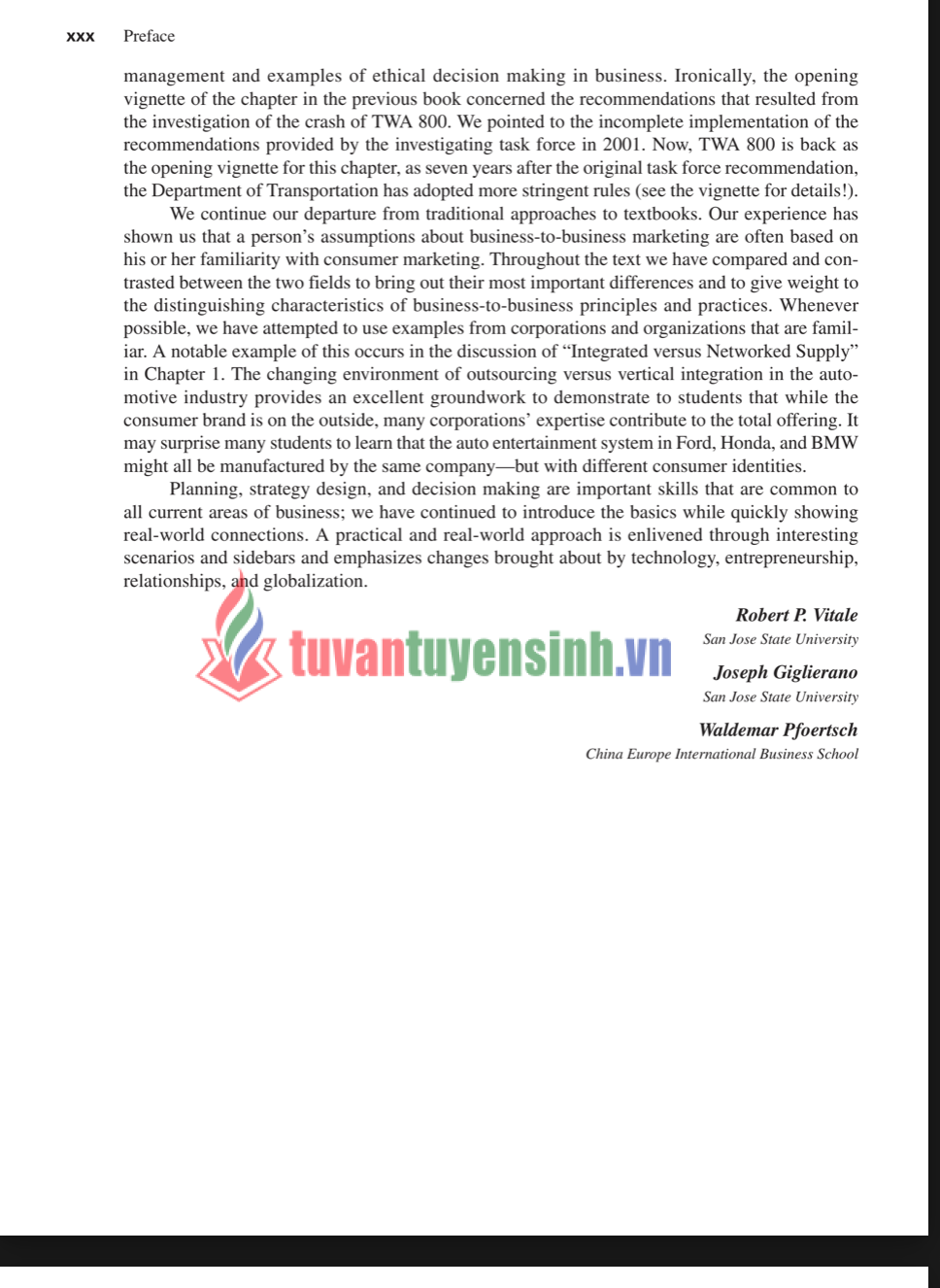
xxx Prefacemanagement and examples of ethical decision making in business. Ironically, the opening vignette of the chapter in the previous book concerned the recommendations that resulted from the investigation of the crash of TWA 800. We pointed to the incomplete implementation of the recommendations provided by the investigating task force in 2001. Now, TWA 800 is back as the opening vignette for this chapter, as seven years after the original task force recommendation, the Department of Transportation has adopted more stringent rules (see the vignette for details!).We continue our departure from traditional approaches to textbooks. Our experience has shown us that a person’s assumptions about business-to-business marketing are often based on his or her familiarity with consumer marketing. Throughout the text we have compared and contrasted between the two fields to bring out their most important differences and to give weight to the distinguishing characteristics of business-to-business principles and practices. Whenever possible, we have attempted to use examples from corporations and organizations that are familiar. A notable example of this occurs in the discussion of “Integrated versus Networked Supply” in Chapter 1. The changing environment of outsourcing versus vertical integration in the automotive industry provides an excellent groundwork to demonstrate to students that while the consumer brand is on the outside, many corporations’ expertise contribute to the total offering. It may surprise many students to learn that the auto entertainment system in Ford, Honda, and BMW might all be manufactured by the same company—but with different consumer identities.Planning, strategy design, and decision making are important skills that are common to all current areas of business; we have continued to introduce the basics while quickly showing real-world connections. A practical and real-world approach is enlivened through interesting scenarios and sidebars and emphasizes changes brought about by technology, entrepreneurship, relationships, and globalization.Robert P. VitaleSan Jose State UniversityJoseph GiglieranoSan Jose State UniversityWaldemar PfoertschChina Europe International Business School


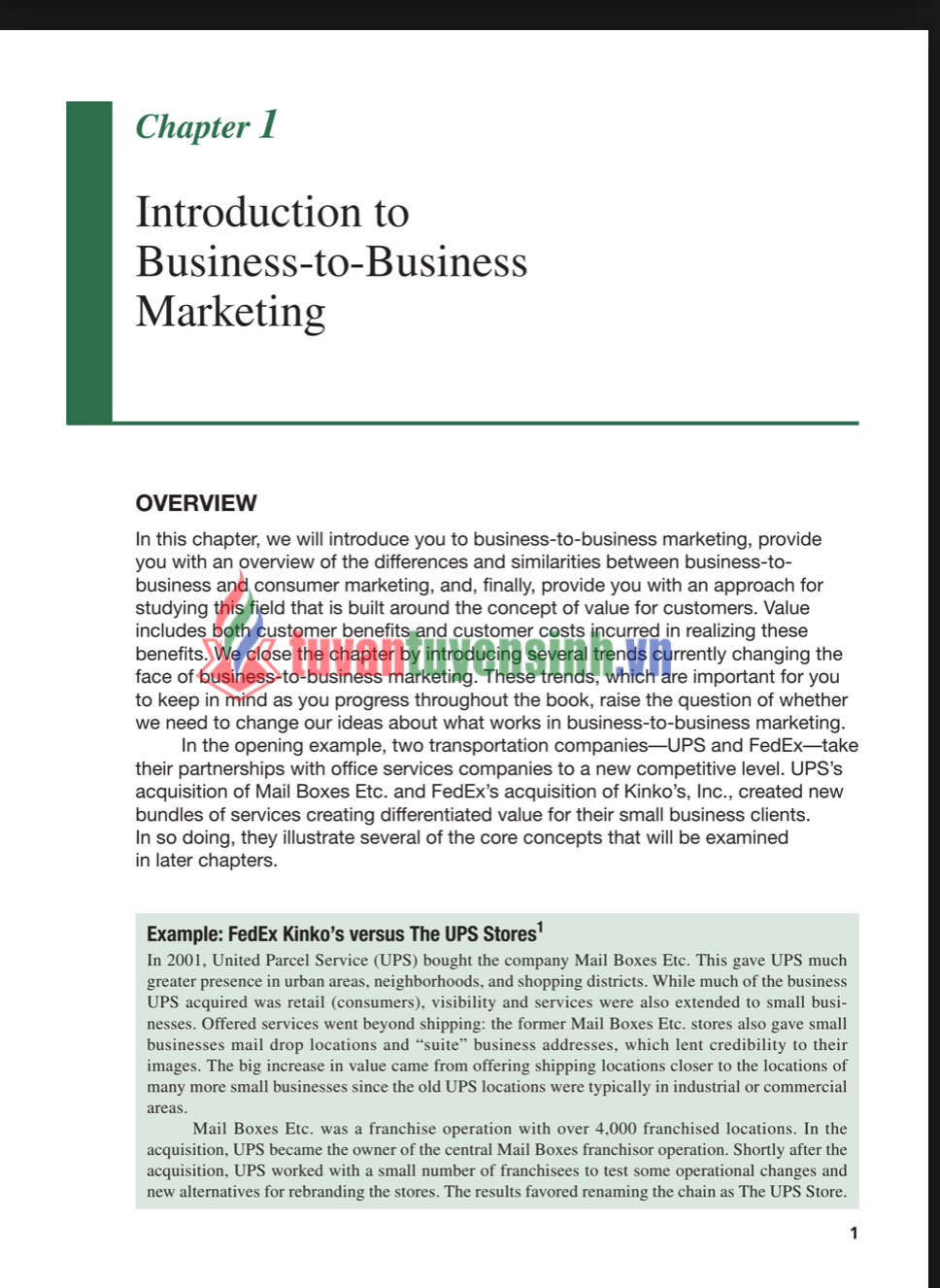
Chapter 1Introduction to Business-to-Business MarketingOVERVIEWIn this chapter, we will introduce you to business-to-business marketing, provide you with an overview of the differences and similarities between business-to-business and consumer marketing, and, finally, provide you with an approach for studying this field that is built around the concept of value for customers. Value includes both customer benefits and customer costs incurred in realizing these benefits. We close the chapter by introducing several trends currently changing the face of business-to-business marketing. These trends, which are important for you to keep in mind as you progress throughout the book, raise the question of whether we need to change our ideas about what works in business-to-business marketing.In the opening example, two transportation companies—UPS and FedEx—take their partnerships with office services companies to a new competitive level. UPS’s acquisition of Mail Boxes Etc. and FedEx’s acquisition of Kinko’s, Inc., created new bundles of services creating differentiated value for their small business clients. In so doing, they illustrate several of the core concepts that will be examined in later chapters.

Example: FedEx Kinko’s versus The UPS Stores¹In 2001, United Parcel Service (UPS) bought the company Mail Boxes Etc. This gave UPS much greater presence in urban areas, neighborhoods, and shopping districts. While much of the business UPS acquired was retail (consumers), visibility and services were also extended to small businesses. Offered services went beyond shipping: the former Mail Boxes Etc. stores also gave small businesses mail drop locations and “suite” business addresses, which lent credibility to their images. The big increase in value came from offering shipping locations closer to the locations of many more small businesses since the old UPS locations were typically in industrial or commercial areas.Mail Boxes Etc. was a franchise operation with over 4,000 franchised locations. In the acquisition, UPS became the owner of the central Mail Boxes franchisor operation. Shortly after the acquisition, UPS worked with a small number of franchisees to test some operational changes and new alternatives for rebranding the stores. The results favored renaming the chain as The UPS Store.

1


2 Chapter 1 • Introduction to Business-to-Business Marketing

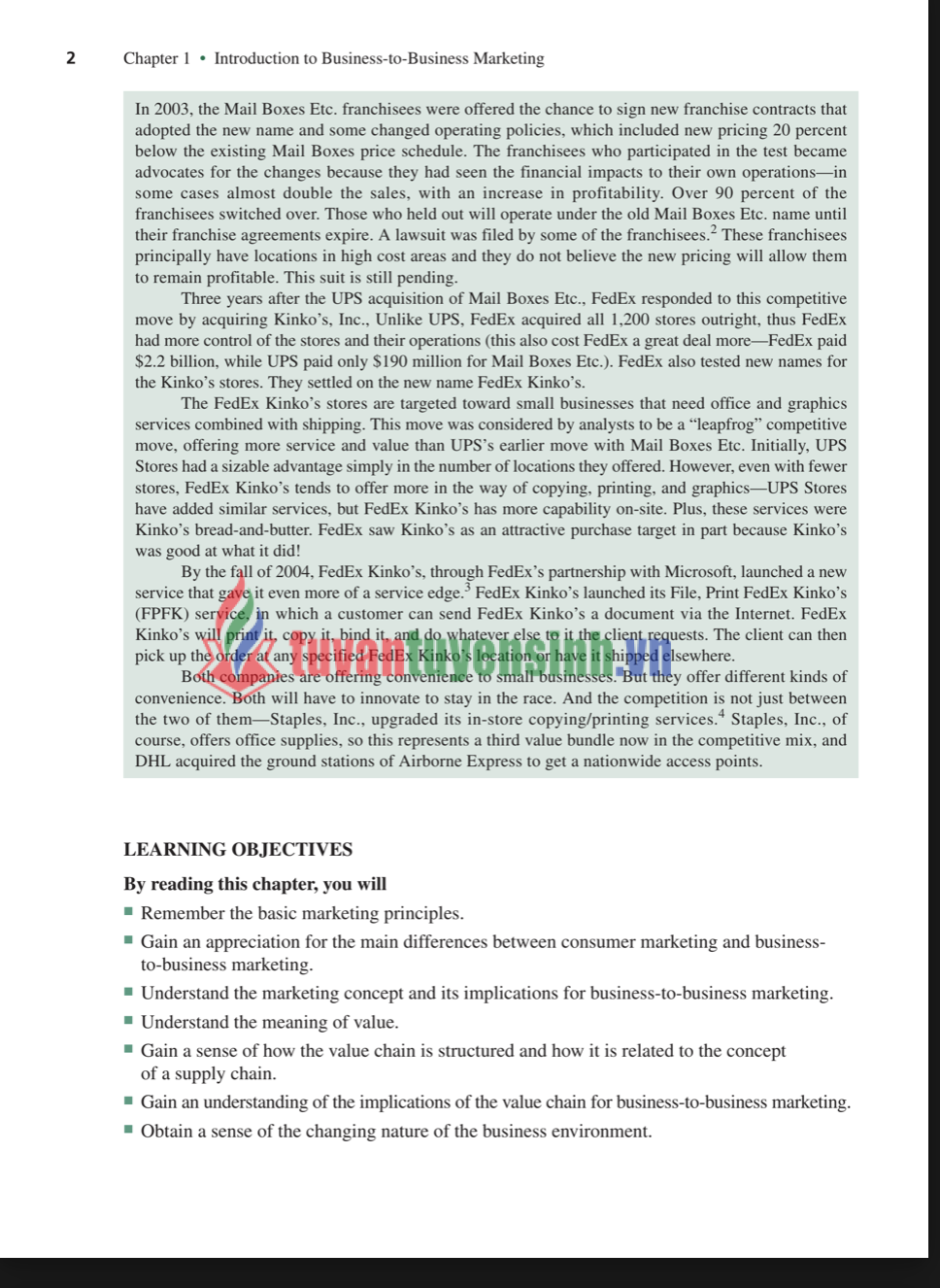
In 2003, the Mail Boxes Etc. franchisees were offered the chance to sign new franchise contracts that adopted the new name and some changed operating policies, which included new pricing 20 percent below the existing Mail Boxes price schedule. The franchisees who participated in the test became advocates for the changes because they had seen the financial impacts to their own operations—in some cases almost double the sales, with an increase in profitability. Over 90 percent of the franchisees switched over. Those who held out will operate under the old Mail Boxes Etc. name until their franchise agreements expire. A lawsuit was filed by some of the franchisees.² These franchisees principally have locations in high cost areas and they do not believe the new pricing will allow them to remain profitable. This suit is still pending.Three years after the UPS acquisition of Mail Boxes Etc., FedEx responded to this competitive move by acquiring Kinko’s, Inc., Unlike UPS, FedEx acquired all 1,200 stores outright, thus FedEx had more control of the stores and their operations (this also cost FedEx a great deal more—FedEx paid $2.2 billion, while UPS paid only $190 million for Mail Boxes Etc.). FedEx also tested new names for the Kinko’s stores. They settled on the new name FedEx Kinko’s.The FedEx Kinko’s stores are targeted toward small businesses that need office and graphics services combined with shipping. This move was considered by analysts to be a “leapfrog” competitive move, offering more service and value than UPS’s earlier move with Mail Boxes Etc. Initially, UPS Stores had a sizable advantage simply in the number of locations they offered. However, even with fewer stores, FedEx Kinko’s tends to offer more in the way of copying, printing, and graphics—UPS Stores have added similar services, but FedEx Kinko’s has more capability on-site. Plus, these services were Kinko’s bread-and-butter. FedEx saw Kinko’s as an attractive purchase target in part because Kinko’s was good at what it did!By the fall of 2004, FedEx Kinko’s, through FedEx’s partnership with Microsoft, launched a new service that gave it even more of a service edge.³ FedEx Kinko’s launched its File, Print FedEx Kinko’s (FPFK) service, in which a customer can send FedEx Kinko’s a document via the Internet. FedEx Kinko’s will print it, copy it, bind it, and do whatever else to it the client requests. The client can then pick up the order at any specified FedEx Kinko’s location or have it shipped elsewhere.Both companies are offering convenience to small businesses. But they offer different kinds of convenience. Both will have to innovate to stay in the race. And the competition is not just between the two of them—Staples, Inc., upgraded its in-store copying/printing services.⁴ Staples, Inc., of course, offers office supplies, so this represents a third value bundle now in the competitive mix, and DHL acquired the ground stations of Airborne Express to get a nationwide access points.

LEARNING OBJECTIVESBy reading this chapter, you will
  • Remember the basic marketing principles.Gain an appreciation for the main differences between consumer marketing and business-to-business marketing.Understand the marketing concept and its implications for business-to-business marketing.Understand the meaning of value.Gain a sense of how the value chain is structured and how it is related to the concept of a supply chain.Gain an understanding of the implications of the value chain for business-to-business marketing.Obtain a sense of the changing nature of the business environment.