



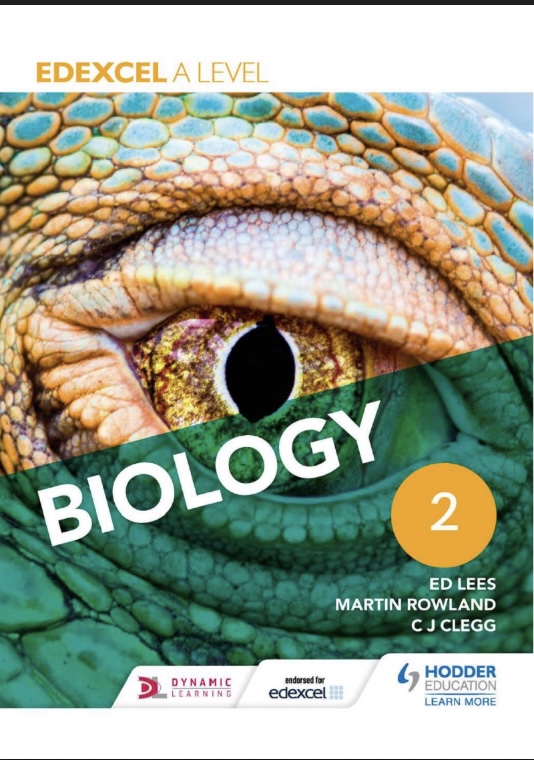
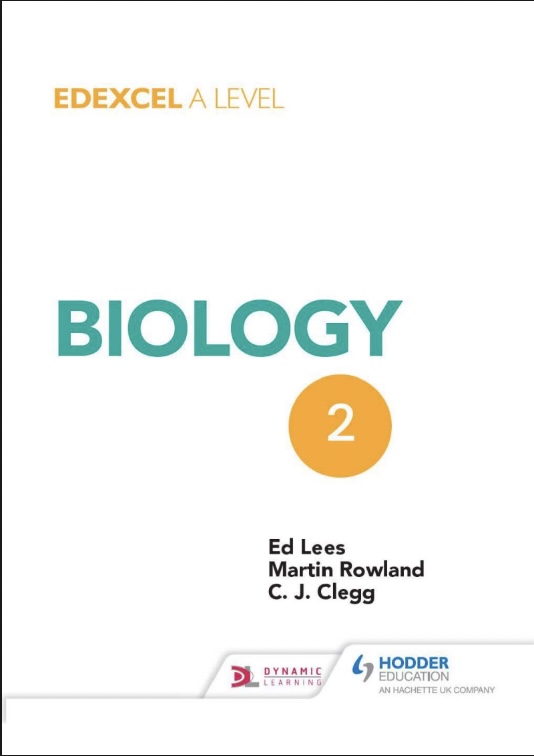
Bạn Đang Tìm Kiếm Tài Liệu Ôn Luyện Chuẩn Quốc Tế Cho Chương Trình A Level? Cuốn Edexcel A Level Biology 2 Chính Là Lựa Chọn Lý Tưởng Dành Cho Học Sinh, Sinh Viên Và Giáo Viên Muốn Nâng Cao Kiến Thức Sinh Học Theo Chuẩn Edexcel – Một Trong Những Hệ Thống Thi Phổ Biến Nhất Tại Anh Và Nhiều Quốc Gia Trên Thế Giới.
Sách Được Biên Soạn Bởi Ed Lees, Martin Rowland Và C. J. Clegg, Do Hodder Education Phát Hành Và Được Chính Thức Endorse Bởi Edexcel. Đây Là Tài Liệu Trọng Tâm Cho Year 2 Của Chương Trình A Level Biology, Phù Hợp Cho Việc Học Tập, Giảng Dạy Và Luyện Thi.
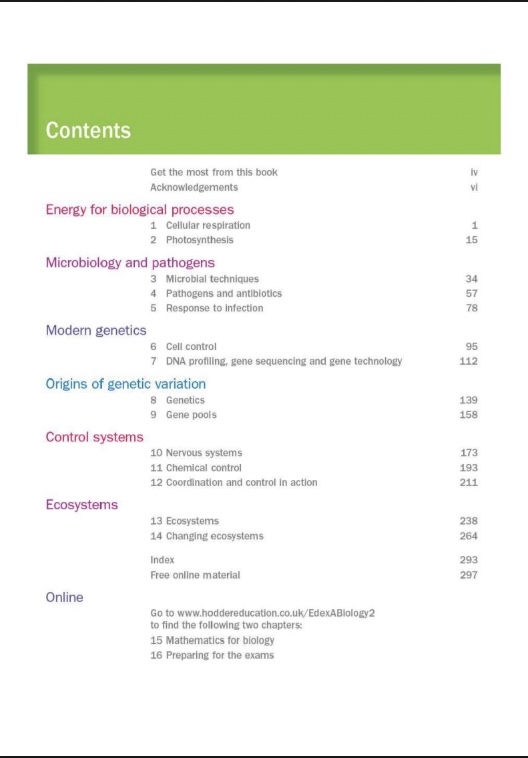
Nội Dung Chính Của Sách:
- Energy For Biological Processes: Hô Hấp Tế Bào, Quang Hợp.
- Microbiology And Pathogens: Kỹ Thuật Vi Sinh, Kháng Sinh, Đáp Ứng Miễn Dịch.
- Modern Genetics: Kiểm Soát Tế Bào, Công Nghệ Gene, Giải Trình Tự DNA.
- Origins Of Genetic Variation: Di Truyền Học Và Quần Thể Gene.
- Control Systems: Hệ Thần Kinh, Điều Hòa Hóa Học, Cơ Chế Phối Hợp.
- Ecosystems: Cấu Trúc Hệ Sinh Thái, Biến Đổi Hệ Sinh Thái.
- Ngoài Ra, Sách Còn Có Tài Liệu Trực Tuyến Bổ Sung: Toán Học Cho Sinh Học Và Hướng Dẫn Chuẩn Bị Cho Kỳ Thi.
Điểm Nổi Bật:
- Trình Bày Khoa Học, Dễ Học Với Phần Key Terms & Formulae Được Đánh Dấu Rõ Ràng.
- Ví Dụ Minh Họa & Bài Tập Kèm Lời Giải Chi Tiết Giúp Người Học Nắm Vững Phương Pháp Làm Bài.
- Được Nhiều Giáo Viên Và Học Sinh Quốc Tế Đánh Giá Cao Trong Quá Trình Ôn Luyện.
Với Cấu Trúc Logic, Hình Ảnh Trực Quan Và Kiến Thức Cập Nhật, Edexcel A Level Biology 2 PDF Sẽ Là Tài Liệu Không Thể Thiếu Cho Những Ai Đang Theo Đuổi Chương Trình A Level Hay Muốn Củng Cố Kiến Thức Sinh Học Hiện Đại.
The steps involved in aerobic cell respiration
The overall outcome of aerobic respiration is that the respiratory substrate, glucose, is broken down to release carbon dioxide, and the hydrogen of glucose is combined with atmospheric oxygen, with the transfer of a large amount of energy. Much of the energy transferred is lost in the form of heat energy, but cells are able to retain significant amounts of chemical energy in ATP.
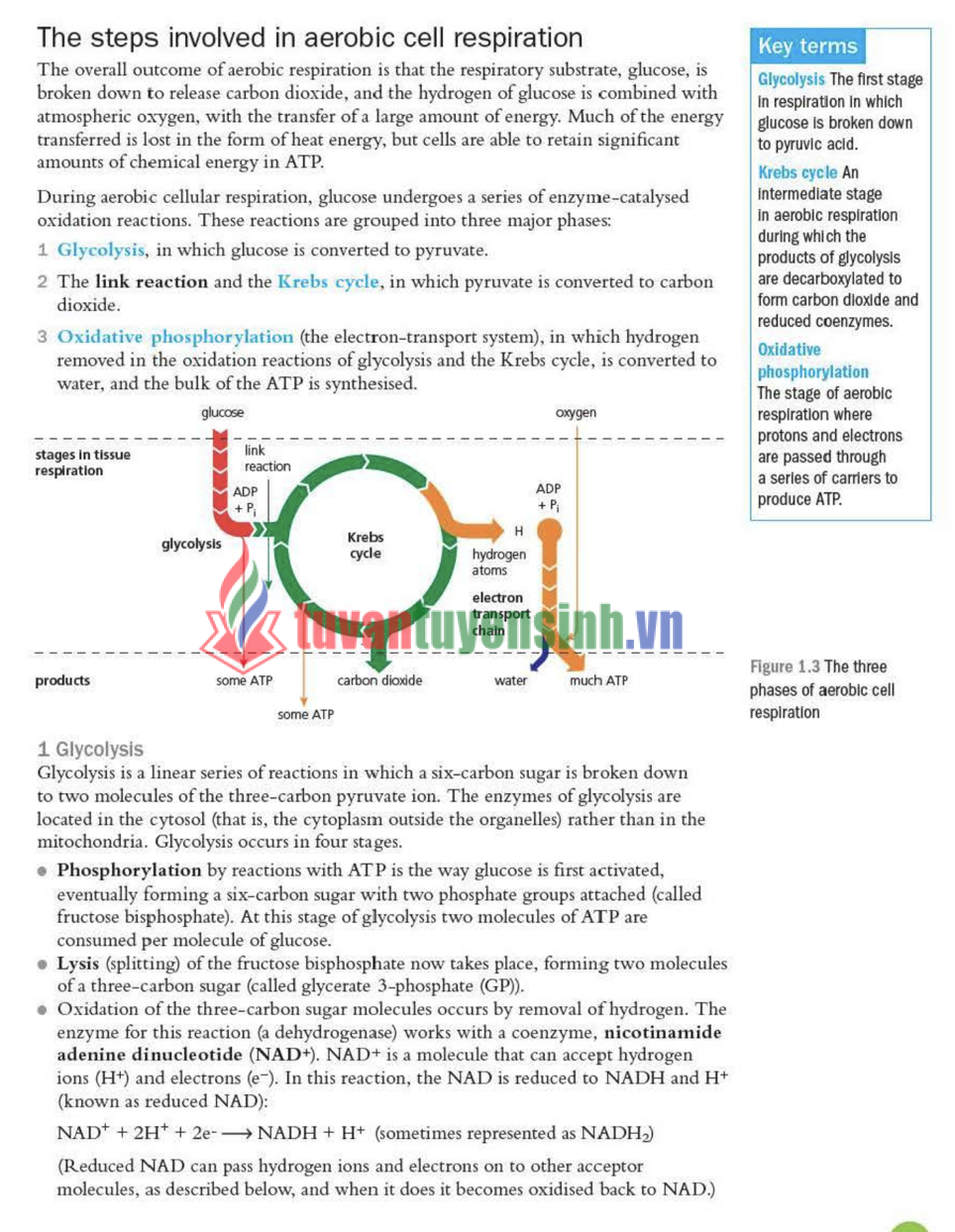
During aerobic cellular respiration, glucose undergoes a series of enzyme-catalysed oxidation reactions. These reactions are grouped into three major phases:
1 Glycolysis, in which glucose is converted to pyruvate.
2 The link reaction and the Krebs cycle, in which pyruvate is converted to carbon dioxide.
3 Oxidative phosphorylation (the electron-transport system), in which hydrogen removed in the oxidation reactions of glycolysis and the Krebs cycle, is converted to water, and the bulk of the ATP is synthesised.
Key terms
Glycolysis The first stage in respiration in which glucose is broken down to pyruvic acid.
Krebs cycle An intermediate stage in aerobic respiration during which the products of glycolysis are decarboxylated to form carbon dioxide and reduced coenzymes.
Oxidative phosphorylation The stage of aerobic respiration where protons and electrons are passed through a series of carriers to produce ATP.
[Diagram text: Figure 1.3 The three phases of aerobic cell respiration]
glucose -> glycolysis -> link reaction -> Krebs cycle -> electron transport chain
stages in tissue respiration
oxygen -> hydrogen atoms -> H -> ADP + Pi -> much ATP
ADP + Pi -> some ATP
products: some ATP, carbon dioxide, some ATP, water, much ATP
1 Glycolysis
Glycolysis is a linear series of reactions in which a six-carbon sugar is broken down to two molecules of the three-carbon pyruvate ion. The enzymes of glycolysis are located in the cytosol (that is, the cytoplasm outside the organelles) rather than in the mitochondria. Glycolysis occurs in four stages.
- Phosphorylation by reactions with ATP is the way glucose is first activated, eventually forming a six-carbon sugar with two phosphate groups attached (called fructose bisphosphate). At this stage of glycolysis two molecules of ATP are consumed per molecule of glucose.
- Lysis (splitting) of the fructose bisphosphate now takes place, forming two molecules of a three-carbon sugar (called glycerate 3-phosphate (GP)).
- Oxidation of the three-carbon sugar molecules occurs by removal of hydrogen. The enzyme for this reaction (a dehydrogenase) works with a coenzyme, nicotinamide adenine dinucleotide (NAD+). NAD+ is a molecule that can accept hydrogen ions (H+) and electrons (e-). In this reaction, the NAD is reduced to NADH and H+ (known as reduced NAD):
NAD+ + 2H+ + 2e-→→NADH + H+ (sometimes represented as NADH22)
(Reduced NAD can pass hydrogen ions and electrons on to other acceptor molecules, as described below, and when it does it becomes oxidised back to NAD.)
2 The link reaction and Krebs cycle
The subsequent steps in aerobic respiration occur in the organelles known as mitochondria.
In the link reaction, pyruvate diffuses into the matrix of the mitochondrion as it forms, and is metabolised there. First, the three-carbon pyruvate is decarboxylated by removal of carbon dioxide and, at the same time, oxidised by removal of hydrogen. Reduced NAD is formed. The product of this oxidative decarboxylation reaction is an acetyl group – a two-carbon fragment. This acetyl group is then combined with a coenzyme called coenzyme A, forming acetyl coenzyme A.
Key term
Coenzyme An organic non-protein molecule that binds to an enzyme to allow it to carry out its function.
The production of acetyl coenzyme A from pyruvate is known as the link reaction because it connects glycolysis to reactions of the Krebs cycle, details of which now follow.
[Reaction equation diagram]
pyruvate + NAD+ + coenzyme A (CoA)
→→
NADH + H+ + CO
22
+ acetyl CoA
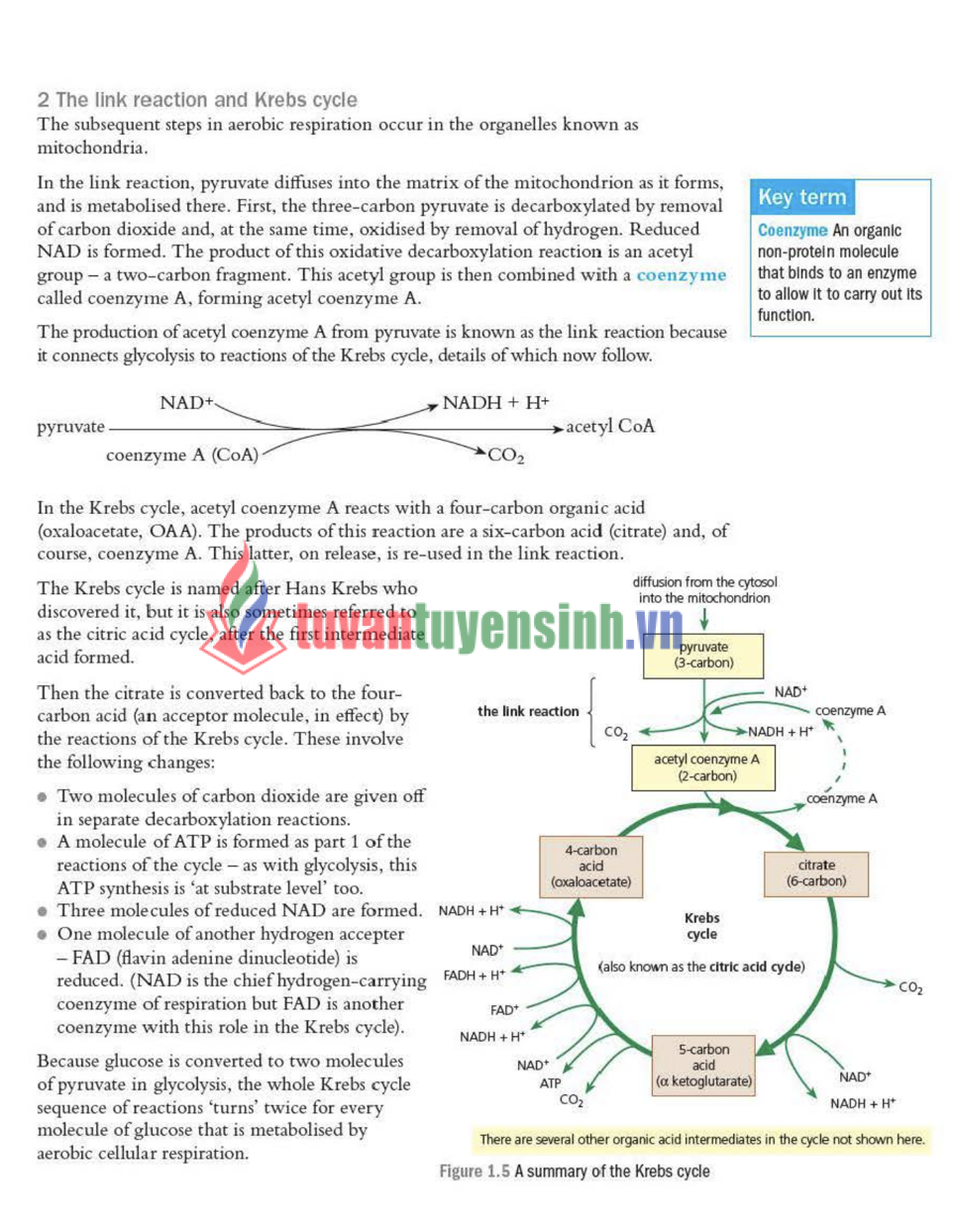
In the Krebs cycle, acetyl coenzyme A reacts with a four-carbon organic acid (oxaloacetate, OAA). The products of this reaction are a six-carbon acid (citrate) and, of course, coenzyme A. This latter, on release, is re-used in the link reaction.
The Krebs cycle is named after Hans Krebs who discovered it, but it is also sometimes referred to as the citric acid cycle, after the first intermediate acid formed.
Then the citrate is converted back to the four-carbon acid (an acceptor molecule, in effect) by the reactions of the Krebs cycle. These involve the following changes:
- Two molecules of carbon dioxide are given off in separate decarboxylation reactions.
- A molecule of ATP is formed as part 1 of the reactions of the cycle – as with glycolysis, this ATP synthesis is ‘at substrate level’ too.
- Three molecules of reduced NAD are formed.
- One molecule of another hydrogen acceptor – FAD (flavin adenine dinucleotide) is reduced. (NAD is the chief hydrogen-carrying coenzyme of respiration but FAD is another coenzyme with this role in the Krebs cycle).
Because glucose is converted to two molecules of pyruvate in glycolysis, the whole Krebs cycle sequence of reactions ‘turns’ twice for every molecule of glucose that is metabolised by aerobic cellular respiration.
[Diagram text: Figure 1.5 A summary of the Krebs cycle]
diffusion from the cytosol into the mitochondrion
→→
pyruvate (3-carbon)
the link reaction: pyruvate
→→
acetyl coenzyme A (2-carbon). CO
22
is removed. NAD+
→→
NADH + H+. coenzyme A is added.
Krebs cycle (also known as the citric acid cycle): acetyl coenzyme A + 4-carbon acid (oxaloacetate)
→→
citrate (6-carbon). coenzyme A is removed.
citrate (6-carbon)
→→
5-carbon acid (
αα
ketoglutarate). NAD+
→→
NADH + H+. CO
22
is removed.
5-carbon acid (
αα
ketoglutarate)
→→
4-carbon acid (oxaloacetate). NAD+
→→
NADH + H+, CO
22
is removed, ATP is produced, NAD+
→→
NADH + H+, FAD
→→
FADH + H+, NAD+
→→
NADH + H+.
There are several other organic acid intermediates in the cycle not shown here.
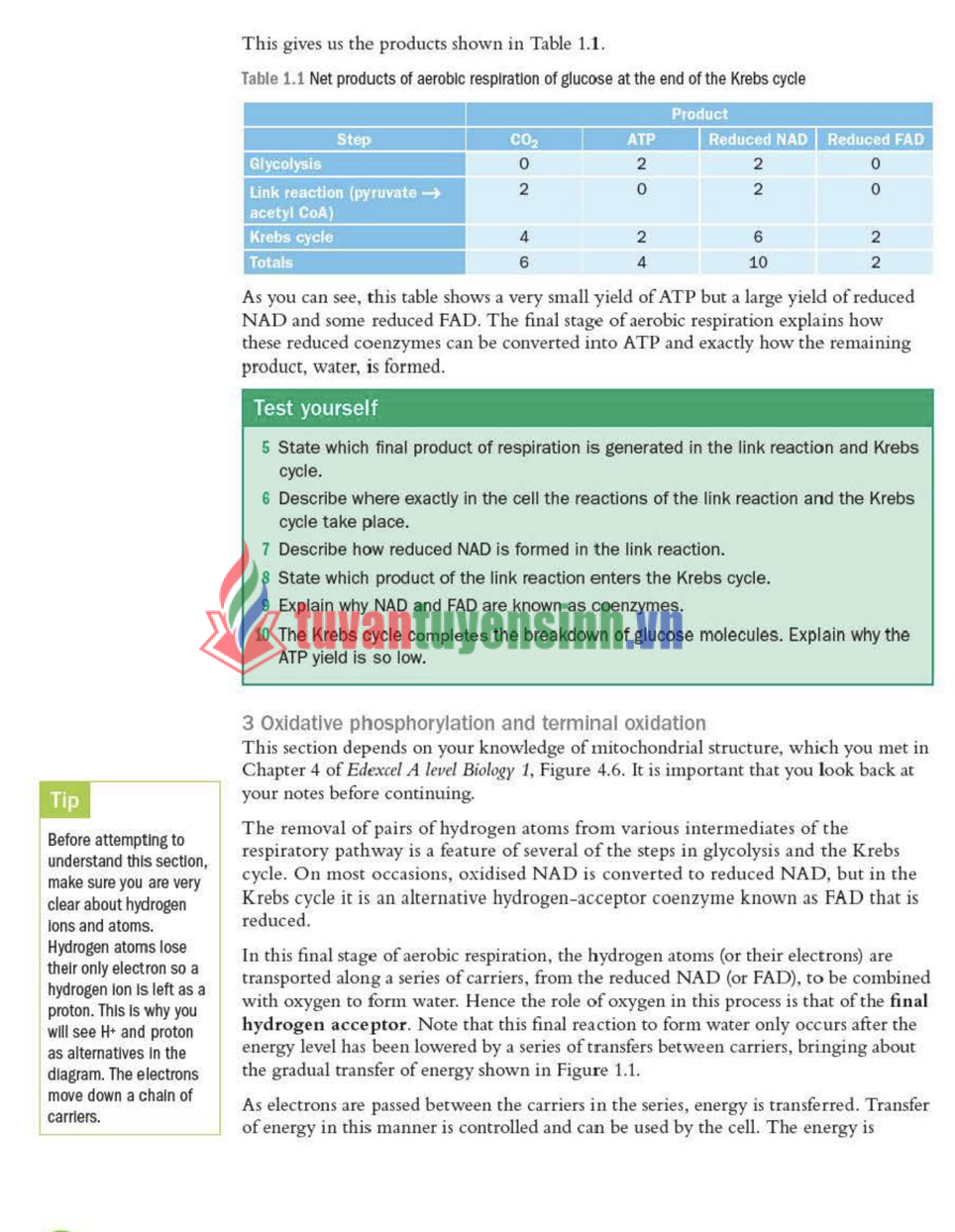
This gives us the products shown in Table 1.1.
Table 1.1 Net products of aerobic respiration of glucose at the end of the Krebs cycle
| Step | Product: CO 22 | Product: ATP | Product: Reduced NAD | Product: Reduced FAD |
| Glycolysis | 0 | 2 | 2 | 0 |
Link reaction (pyruvate →→ acetyl CoA) | 2 | 0 | 2 | 0 |
| Krebs cycle | 4 | 2 | 6 | 2 |
| Totals | 6 | 4 | 10 | 2 |
As you can see, this table shows a very small yield of ATP but a large yield of reduced NAD and some reduced FAD. The final stage of aerobic respiration explains how these reduced coenzymes can be converted into ATP and exactly how the remaining product, water, is formed.
Test yourself
5 State which final product of respiration is generated in the link reaction and Krebs cycle.
6 Describe where exactly in the cell the reactions of the link reaction and the Krebs cycle take place.
7 Describe how reduced NAD is formed in the link reaction.
8 State which product of the link reaction enters the Krebs cycle.
9 Explain why NAD and FAD are known as coenzymes.
10 The Krebs cycle completes the breakdown of glucose molecules. Explain why the ATP yield is so low.
3 Oxidative phosphorylation and terminal oxidation
This section depends on your knowledge of mitochondrial structure, which you met in Chapter 4 of Edexcel A level Biology 1, Figure 4.6. It is important that you look back at your notes before continuing.
Tip
Before attempting to understand this section, make sure you are very clear about hydrogen ions and atoms. Hydrogen atoms lose their only electron so a hydrogen ion is left as a proton. This is why you will see H+ and proton as alternatives in the diagram. The electrons move down a chain of carriers.
The removal of pairs of hydrogen atoms from various intermediates of the respiratory pathway is a feature of several of the steps in glycolysis and the Krebs cycle. On most occasions, oxidised NAD is converted to reduced NAD, but in the Krebs cycle it is an alternative hydrogen-acceptor coenzyme known as FAD that is reduced.
In this final stage of aerobic respiration, the hydrogen atoms (or their electrons) are transported along a series of carriers, from the reduced NAD (or FAD), to be combined with oxygen to form water. Hence the role of oxygen in this process is that of the final hydrogen acceptor. Note that this final reaction to form water only occurs after the energy level has been lowered by a series of transfers between carriers, bringing about the gradual transfer of energy shown in Figure 1.1.