

Giới Thiệu E-Book: JLPT N5 Grammar Master – Làm Chủ Ngữ Pháp Tiếng Nhật Căn Bản Trong Tay Bạn
Lời Mở Đầu: Khởi Đầu Vững Chắc Với Ngữ Pháp N5
Tiếng Nhật, với cấu trúc câu khác biệt, luôn là một thử thách lớn đối với người mới bắt đầu. Để chinh phục thành công kỳ thi Năng lực Tiếng Nhật (JLPT) cấp độ N5 – cánh cửa đầu tiên bước vào thế giới Nhật ngữ – việc nắm vững các cấu trúc ngữ pháp cơ bản là yếu tố tiên quyết. Cuốn sách JLPT N5 Grammar Master e-Book chính là giải pháp ôn luyện ngữ pháp toàn diện, được thiết kế tối ưu hóa cho người học hiện đại, mang lại sự tiện lợi tối đa thông qua định dạng sách điện tử.
JLPT N5 Grammar Master: Chuyên Gia Về Ngữ Pháp Sơ Cấp
Cuốn sách này được biên soạn với một mục tiêu duy nhất: giúp người học làm chủ mọi điểm ngữ pháp cần thiết trong chương trình N5 (khoảng 100 điểm ngữ pháp cơ bản) và sẵn sàng cho kỳ thi JLPT N5. Định dạng e-Book mang lại lợi thế cạnh tranh vượt trội, cho phép bạn học mọi lúc, mọi nơi mà không cần mang vác sách giấy nặng nề.
Cấu Trúc Học Tập Khoa Học và Toàn Diện
JLPT N5 Grammar Master áp dụng một phương pháp tiếp cận có hệ thống, biến ngữ pháp khô khan thành nội dung dễ tiếp thu:
1. Phân Loại Theo Chủ Điểm Rõ Ràng
Tất cả các mẫu ngữ pháp đều được sắp xếp theo từng đơn vị bài học logic, thường là theo các chủ đề như: trình bày câu trần thuật, câu phủ định, câu hỏi, giới thiệu về thời gian, địa điểm, khả năng cơ bản, hoặc các trợ từ thông dụng. Sự phân chia này giúp người học không bị quá tải khi tiếp thu kiến thức mới.
2. Giải Thích Ngữ Pháp Đơn Giản và Trực Quan
Mỗi mẫu ngữ pháp (ví dụ: N1 は N2 です; N は adj. です) đều được giải thích rõ ràng về:
- Cấu trúc: Công thức kết hợp (Cách chia động từ/danh từ + ngữ pháp).
- Ý nghĩa: Giải thích trực tiếp bằng ngôn ngữ dễ hiểu (thường có kèm song ngữ Anh/Việt).
- Ví dụ Minh Họa: Cung cấp các câu ví dụ thực tế, cụ thể, giúp người học hình dung được ngữ cảnh sử dụng tự nhiên nhất.
3. Hệ Thống Bài Tập Đa Dạng và Tăng Dần Độ Khó
Đây là phần cốt lõi của một cuốn Workbook. Sách tích hợp nhiều loại hình bài tập được thiết kế để củng cố việc ghi nhớ và khả năng áp dụng:
- Điền từ/Chọn mẫu ngữ pháp: Kiểm tra khả năng nhớ cấu trúc cơ bản.
- Hoàn thành câu: Yêu cầu người học sử dụng ngữ pháp đã học để tạo nên câu văn hoàn chỉnh trong bối cảnh nhất định.
- Đoạn hội thoại ngắn: Luyện tập khả năng nhận diện và sử dụng ngữ pháp trong giao tiếp thực tế.
4. Tích Hợp Tính Năng E-Book Độc Đáo
Là một E-Book, cuốn sách này tận dụng công nghệ để tối đa hóa trải nghiệm học tập:
- Tìm kiếm nhanh (Search Function): Dễ dàng tra cứu bất kỳ mẫu ngữ pháp nào bạn cần ôn tập ngay lập tức.
- Ghi chú và Đánh dấu: Người học có thể tự do ghi chú bên cạnh các mẫu câu khó nhớ hoặc đánh dấu các phần cần xem lại.
- Tính di động: Học mọi lúc trên điện thoại, máy tính bảng hoặc máy tính, lý tưởng cho những người bận rộn.
Ai Nên Sử Dụng Cuốn Sách Này?
JLPT N5 Grammar Master e-Book là tài liệu không thể thiếu cho:
- Người mới bắt đầu: Những ai đang học theo giáo trình Minna no Nihongo (bài 1-25) hoặc Genki I và đang chuẩn bị cho kỳ thi JLPT N5.
- Người muốn ôn tập tổng hợp: Những người đã học xong N5 nhưng muốn hệ thống hóa kiến thức ngữ pháp một cách nhanh chóng trước khi chuyển sang N4.
Với sự tập trung chuyên sâu vào ngữ pháp N5, JLPT N5 Grammar Master e-Book sẽ giúp bạn xây dựng một nền tảng ngôn ngữ vững vàng, sẵn sàng chinh phục các cấp độ cao hơn của tiếng Nhật một cách tự tin và hiệu quả.
Nội Dung Trích Xuất Từ Các Trang Sách (Đầy Đủ)
Trang Bìa (Bìa trước)
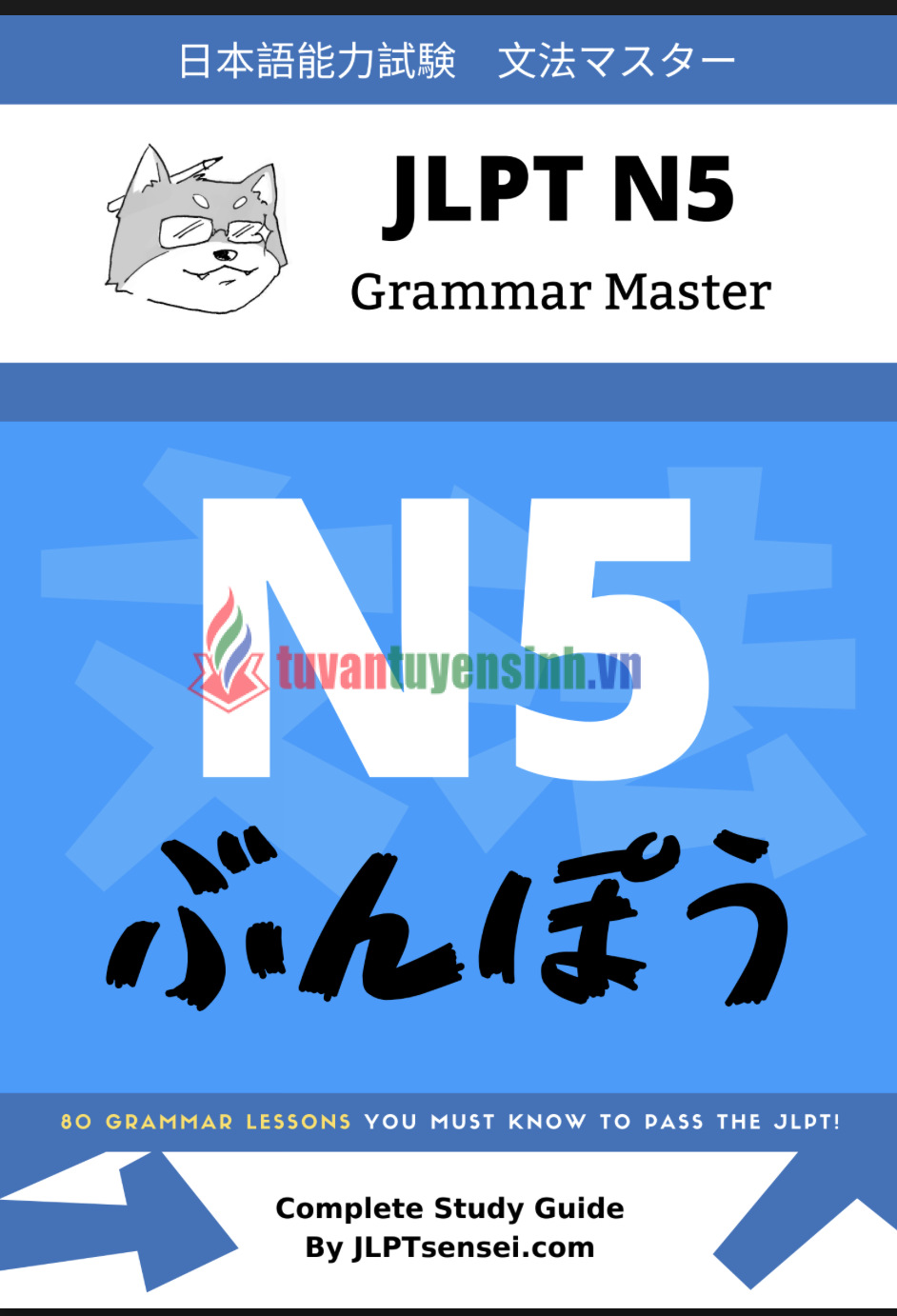
日本語能力試験 文法マスター
JLPT N5 Grammar Master
(Hình ảnh linh vật)
N5
ぶんぽう
80 GRAMMAR LESSONS YOU MUST KNOW TO PASS THE JLPT!
Complete Study Guide
By JLPTsensei.com
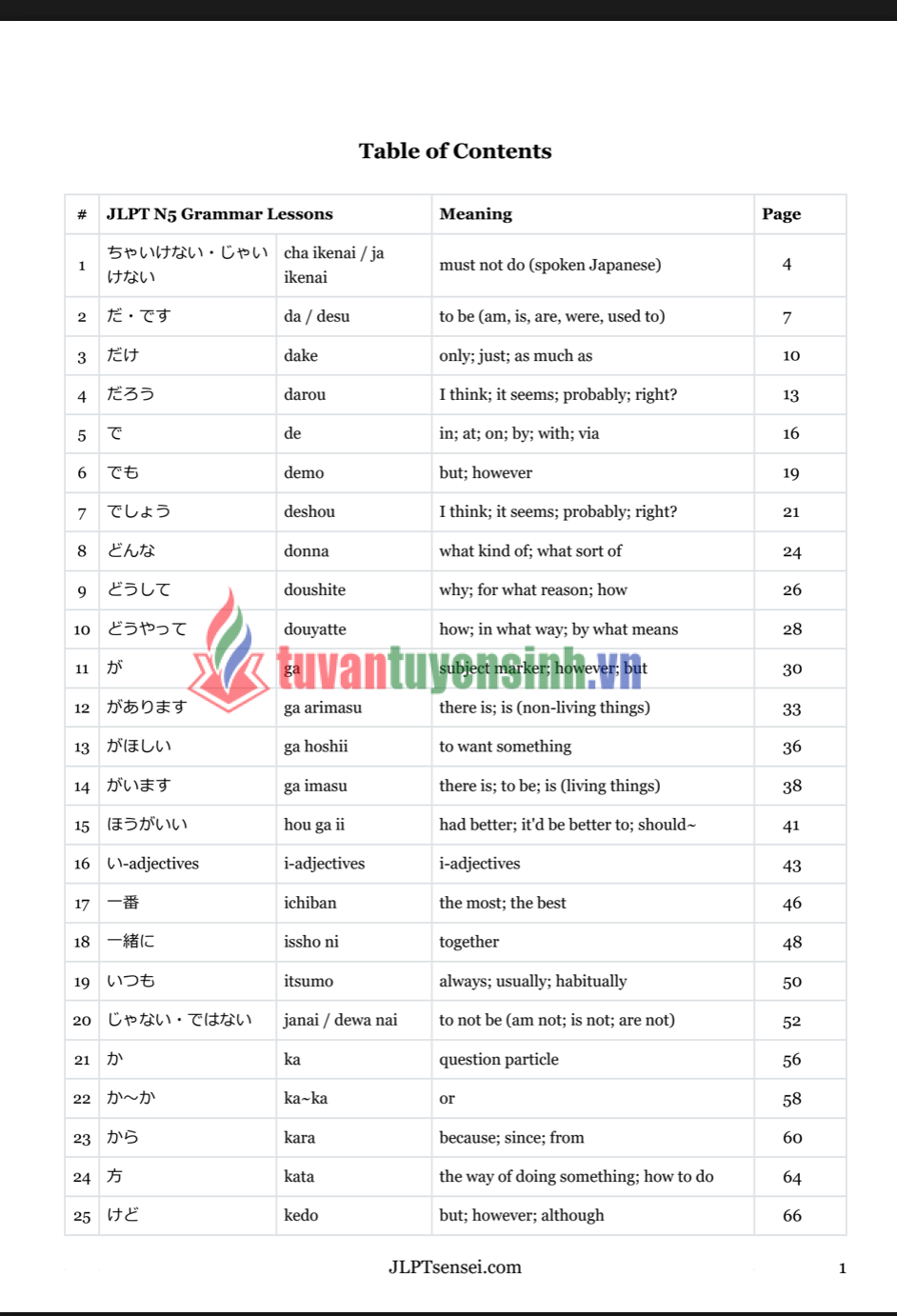
Trang 1 (Table of Contents – Trang 1/3)
Table of Contents
| # | JLPT N5 Grammar Lessons | Meaning | Page |
| 1 | ちゃいけない・じゃいけない | cha ikenai / ja ikenai | 4 |
| 2 | だ・です | da / desu | 7 |
| 3 | だけ | dake | only; just; as much as |
| 4 | だろう | darou | I think; it seems; probably; right? |
| 5 | で | de | in; at; on; by; with; via |
| 6 | でも | demo | but; however |
| 7 | でしょう | deshou | I think; it seems; probably; right? |
| 8 | どんな | donna | what kind of; what sort of |
| 9 | どうして | doushite | why; for what reason; how |
| 10 | どうやって | douyatte | how; in what way; by what means |
| 11 | が | ga | subject marker; however, but |
| 12 | があります | ga arimasu | there is; is (non-living things) |
| 13 | がほしい | ga hoshii | to want something |
| 14 | がいます | ga imasu | there is to be; is (living things) |
| 15 | ほうがいい | hou ga ii | had better; it’d be better to; should~ |
| 16 | い-adjectives | i-adjectives | i-adjectives |
| 17 | 一番 | ichiban | the most; the best |
| 18 | 一緒に | issho ni | together |
| 19 | いつも | itsumo | always; usually; habitually |
| 20 | じゃない・ではない | janai / dewa nai | to not be (am not; is not; are not) |
| 21 | か | ka | question particle |
| 22 | か~か | ka-ka | or |
| 23 | から | kara | because; since; from |
| 24 | 方 | kata | the way of doing something; how to do |
| 25 | けど | kedo | but; however; although |
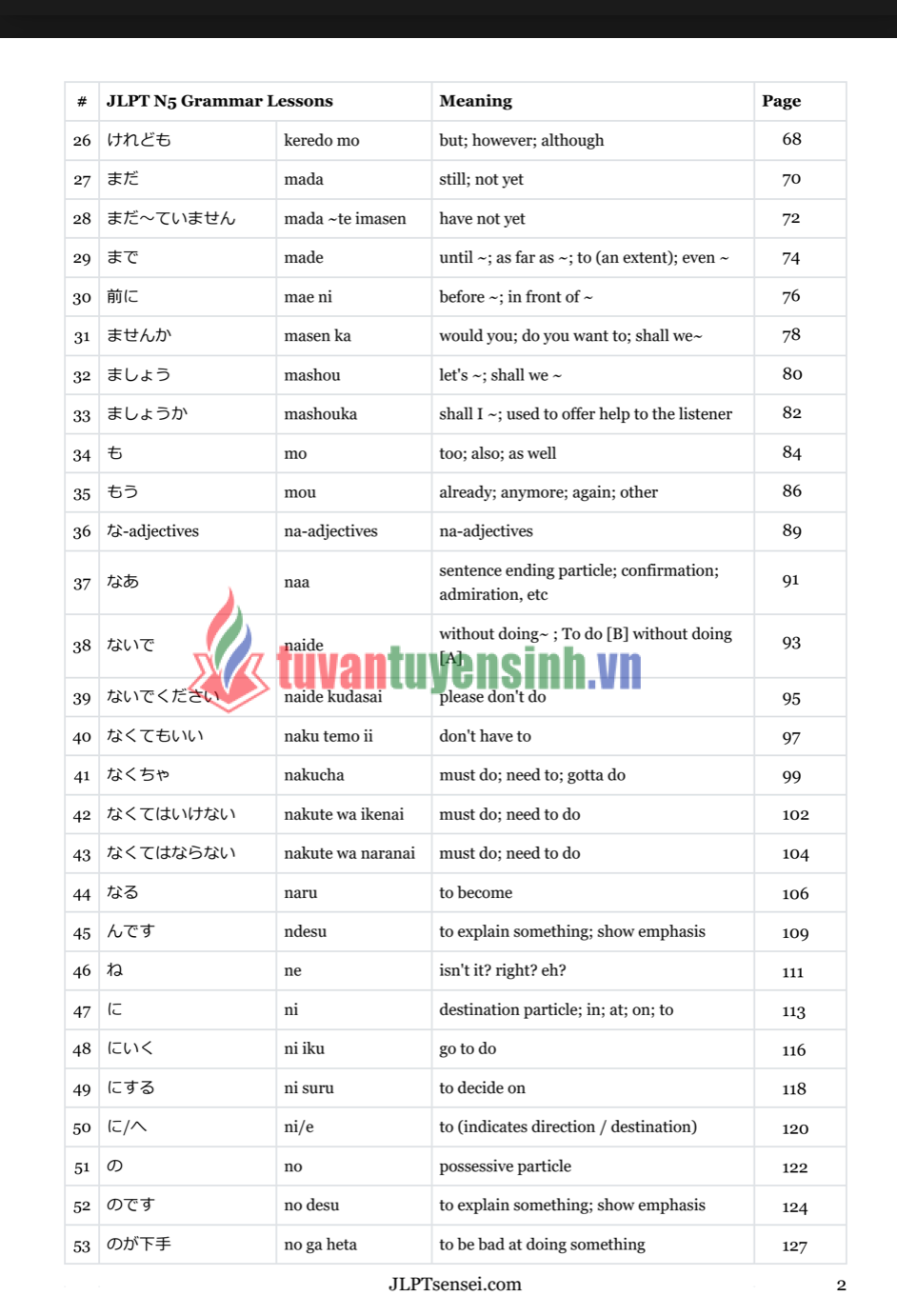
Trang 2 (Table of Contents – Trang 2/3)
| # | JLPT N5 Grammar Lessons | Meaning | Page |
| 26 | けれども | keredo mo | but; however; although |
| 27 | まだ | mada | still; not yet |
| 28 | まだ~ていません | mada ~te imasen | have not yet |
| 29 | まで | made | until; as far as ~; to (an extent) even ~ |
| 30 | 前に | mae ni | before ~; in front of ~ |
| 31 | ませんか | masen ka | would you; do you want to; shall we ~ |
| 32 | ましょう | mashou | let’s ~; shall we ~ |
| 33 | ましょうか | mashouka | shall I ~; used to offer help to the listener |
| 34 | も | mo | too; also; as well |
| 35 | もう | mou | already; anymore; again; other |
| 36 | な-adjectives | na-adjectives | na-adjectives |
| 37 | なあ | naa | sentence ending particle; confirmation, admiration, etc |
| 38 | ないで | naide | without doing ~; To do [B] without doing [A] |
| 39 | ないでください | naide kudasai | please don’t do |
| 40 | なくてもいい | nakutemo ii | don’t have to |
| 41 | なくちゃ | nakucha | must do; need to; gotta do |
| 42 | なくくてはいけない | nakute wa ikenai | must do; need to do |
| 43 | なくくてはならない | nakute wa naranai | must do; need to do |
| 44 | なる | naru | to become |
| 45 | んです | ndesu | to explain something; show emphasis |
| 46 | ね | ne | isn’t it? right? eh? |
| 47 | に | ni | destination particle; in; at; on; to |
| 48 | にいく | ni iku | go to do |
| 49 | にする | ni suru | to decide on |
| 50 | に/へ | ni/e | (indicates direction / destination) |
| 51 | の | no | possessive particle |
| 52 | のです | no desu | to explain something; show emphasis |
| 53 | のが下手 | no ga heta | to be bad at acting |
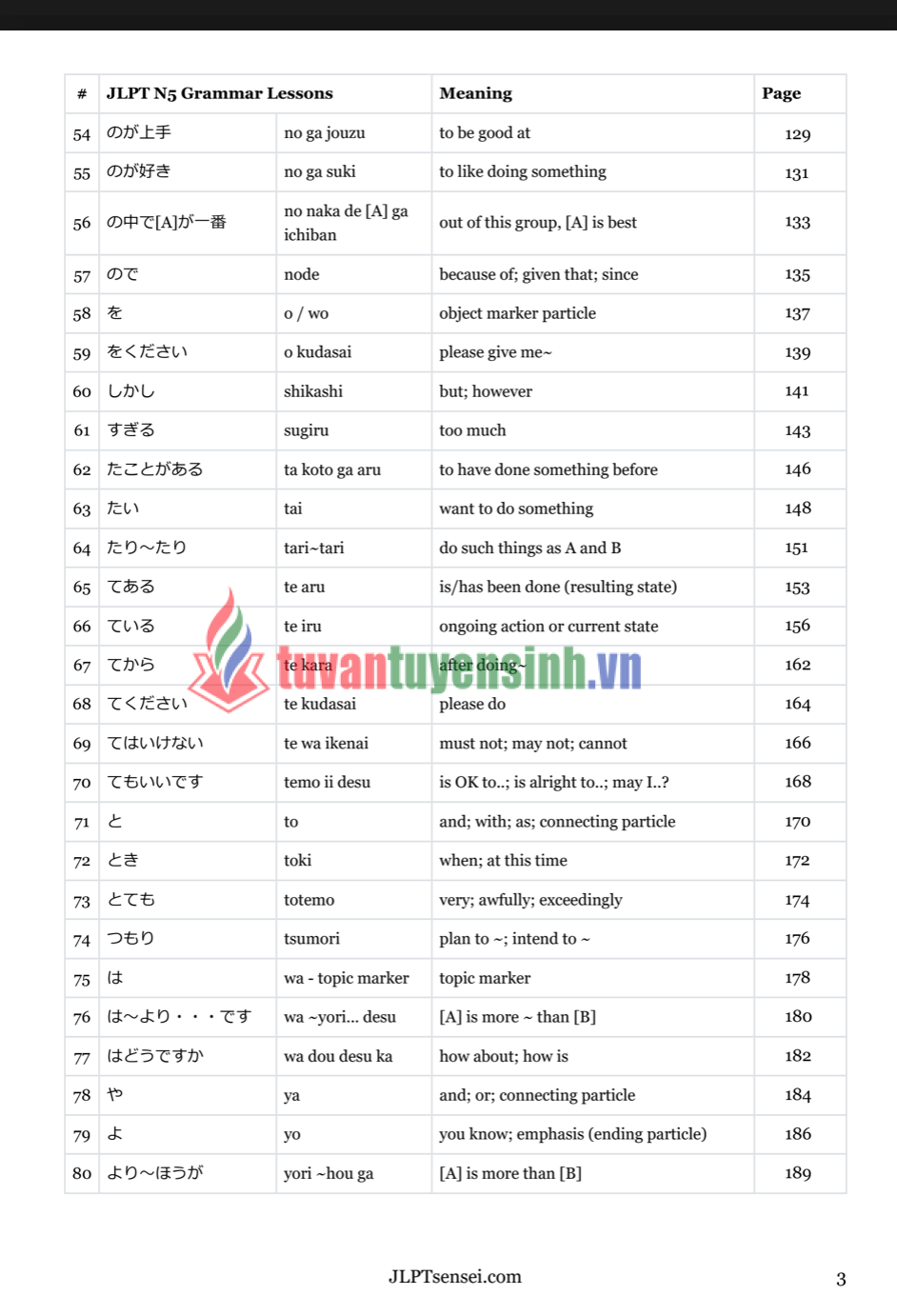
Trang 3 (Table of Contents – Trang 3/3)
| # | JLPT N5 Grammar Lessons | Meaning | Page |
| 54 | のが上手 | no ga jouzu | to be good at |
| 55 | のが好き | no ga suki | to like doing something |
| 56 | の中で[A]が一番 | no naka de [A] ga ichiban | out of this group, [A] is best |
| 57 | ので | node | because of; given that; since |
| 58 | を | o / wo | object marker particle |
| 59 | をください | o kudasai | please give me ~ |
| 60 | しかし | shikashi | but; however |
| 61 | すぎる | sugiru | too much |
| 62 | たことがある | ta koto ga aru | to have done something before |
| 63 | たい | tai | want to do something |
| 64 | たり~たり | tari~tari | do such things as A and B |
| 65 | てある | te aru | is/has been done (resulting state) |
| 66 | ている | te iru | ongoing action or current state |
| 67 | てから | te kara | after doing~ |
| 68 | てください | te kudasai | please do |
| 69 | てはいけない | te wa ikenai | must not; may not; cannot |
| 70 | てもいいです | temo ii desu | is OK to…; is alright to…; may I…? |
| 71 | と | to | and; with; as; connecting particle |
| 72 | とき | toki | when; at this time |
| 73 | とても | totemo | very; awfully; exceedingly |
| 74 | つもり | tsumori | plan to ~; intend to ~ |
| 75 | は | wa ~ topic marker | topic marker |
| 76 | は~より・・・です | wa ~yori … desu | [A] is more than [B] |
| 77 | はどうですか | wa dou desu ka | how about; how is |
| 78 | や | ya | and; or; connecting particle |
| 79 | よ | yo | you know; emphasis (ending particle) |
| 80 | より~ほうが | yori ~hou ga | [A] is more than [B] |
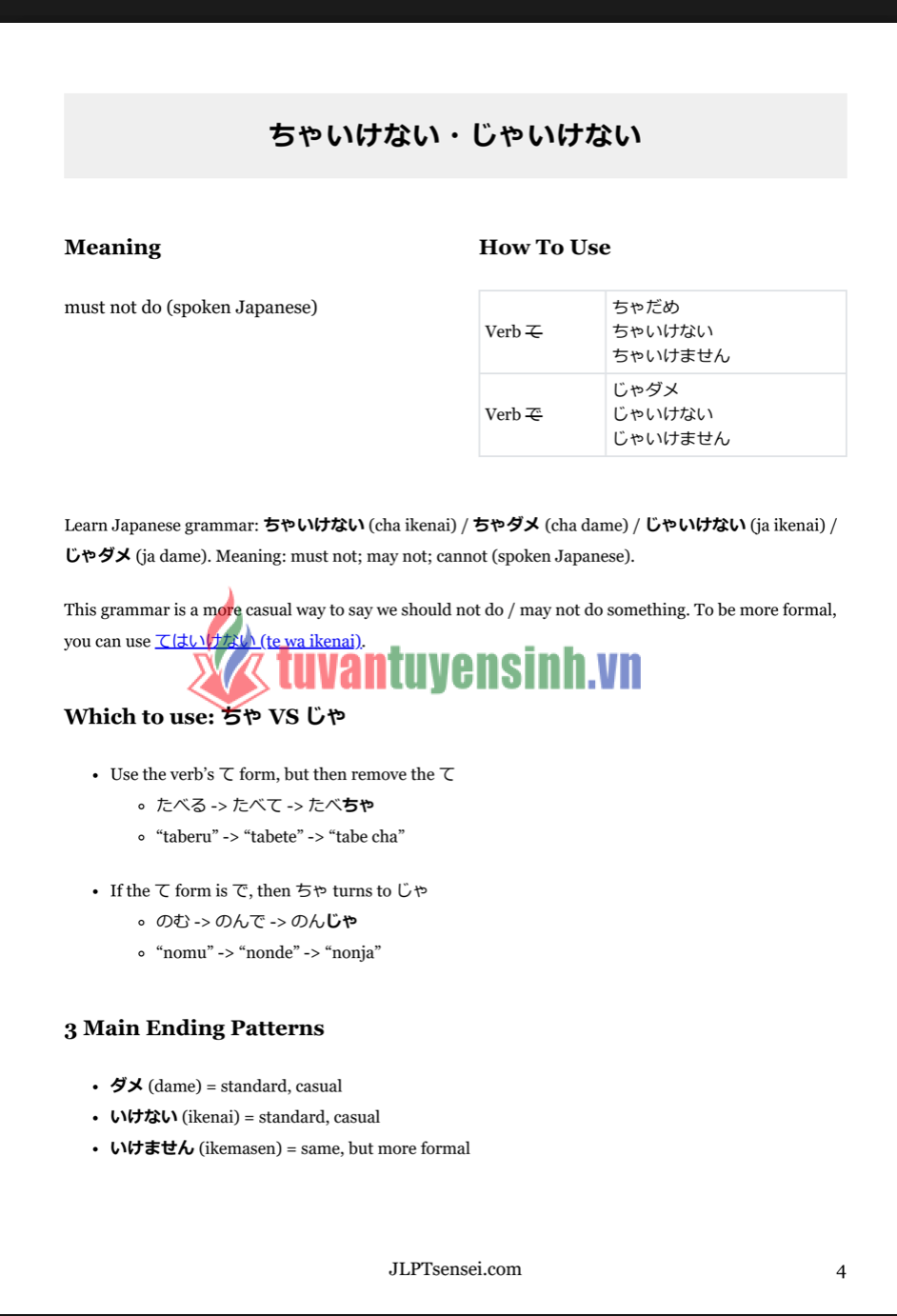
Trang 4 (Bài 1: ちゃいけない・じゃいけない)
ちゃいけない・じゃいけない
Meaning
must not do (spoken Japanese)
How To Use
| Verb て | ちゃだめ |
| ちゃいけません | |
| Verb て | じゃダメ |
| じゃいけません |
Learn Japanese grammar: ちゃいけない (cha ikenai) / ちゃダメ (cha dame) / じゃいけない (ja ikenai) / じゃダメ (ja dame). Meaning: must not; may not; cannot (spoken Japanese).
This grammar is a more casual way to say we should not do / may not do something. To be more formal, you can use てはいけない (te wa ikenai).
Which to use: ちゃ VS じゃ
- Use the verb’s て form, but then remove the て
- のむ -> のんで -> のんじゃ
- “nomu” -> “nonde” -> “nonja”
- Use the verb’s て form is て, then て turns to じゃ
- のむ -> のんで -> のんじゃ
- “nomu” -> “nonde” -> “nonja”
3 Main Ending Patterns
- ダメ (dame) = standard, casual
- いけない (ikenai) = standard, casual
- いけません (ikemasen) = same, but more formal
Trang 5 (Bài 1: Example Sentences)
Example Sentences
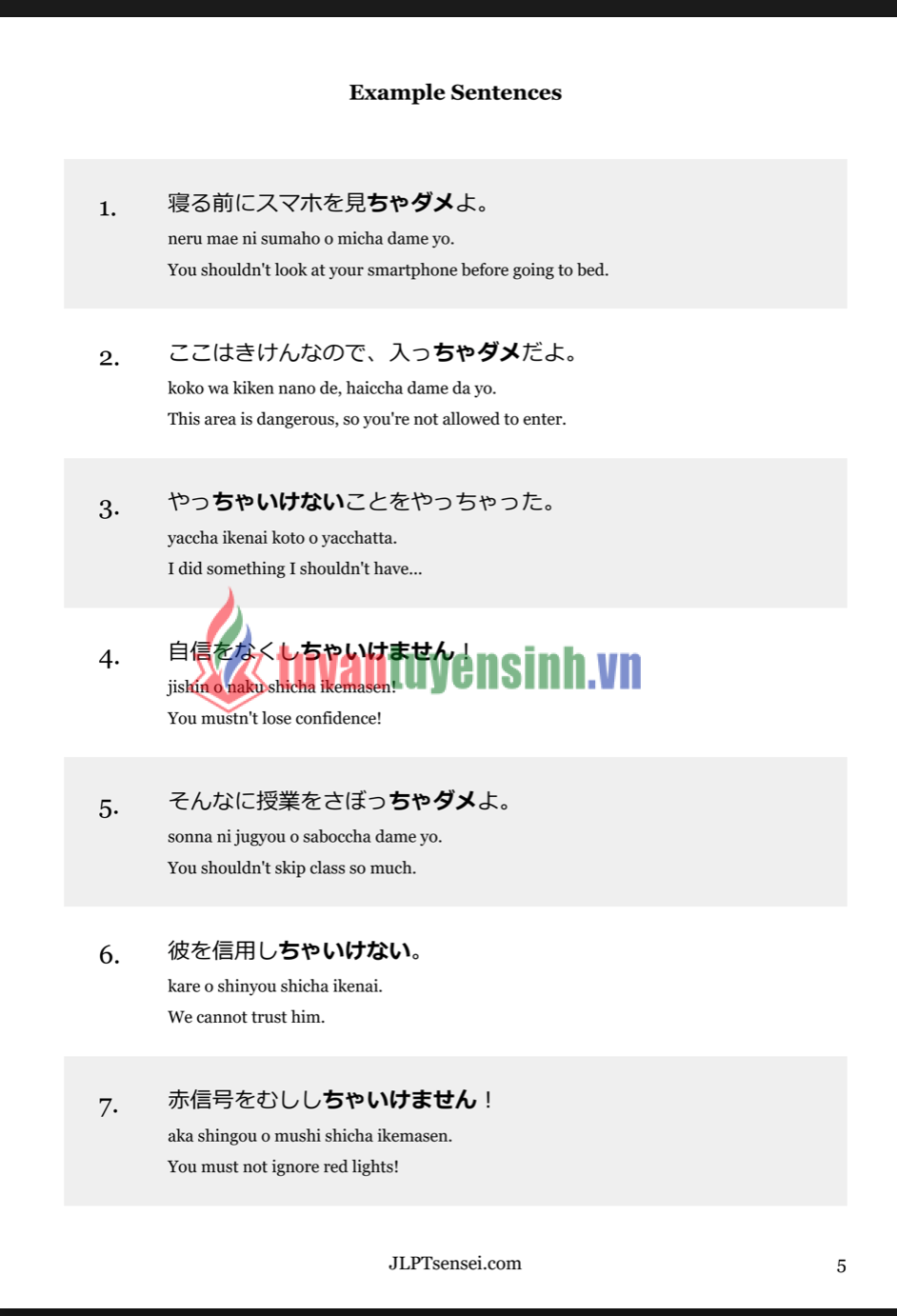
- 寝る前にスマホを見ちゃダメよ。
neru mae ni sumaho o micha dame yo.
You shouldn’t look at your smartphone before going to bed. - ここはこぎゃけないので、入っちゃダメだよ。
koko wa kiken nano de, haiccha dame da yo.
This area is dangerous, so you’re not allowed to enter. - やっっちゃいけないことをやっちゃった。
yaccha ikenai koto o yacchatta.
I did something I shouldn’t have… - 自信をなくしちゃいけません!
jishin o naku shicha ikemasen!
You mustn’t lose confidence! - そんなに授業をさぼっちゃダメよ。
sonna ni jugyou o saboccha dame yo.
You shouldn’t skip class so much. - 彼を信用しちゃいけない。
kare o shinyou shicha ikenai.
We cannot trust him. - 赤信号をむししちゃいけません!
aka shingou o mushi shicha ikemasen.
You must not ignore red lights!
Trang 6 (Bài 1: Example Sentences continued)
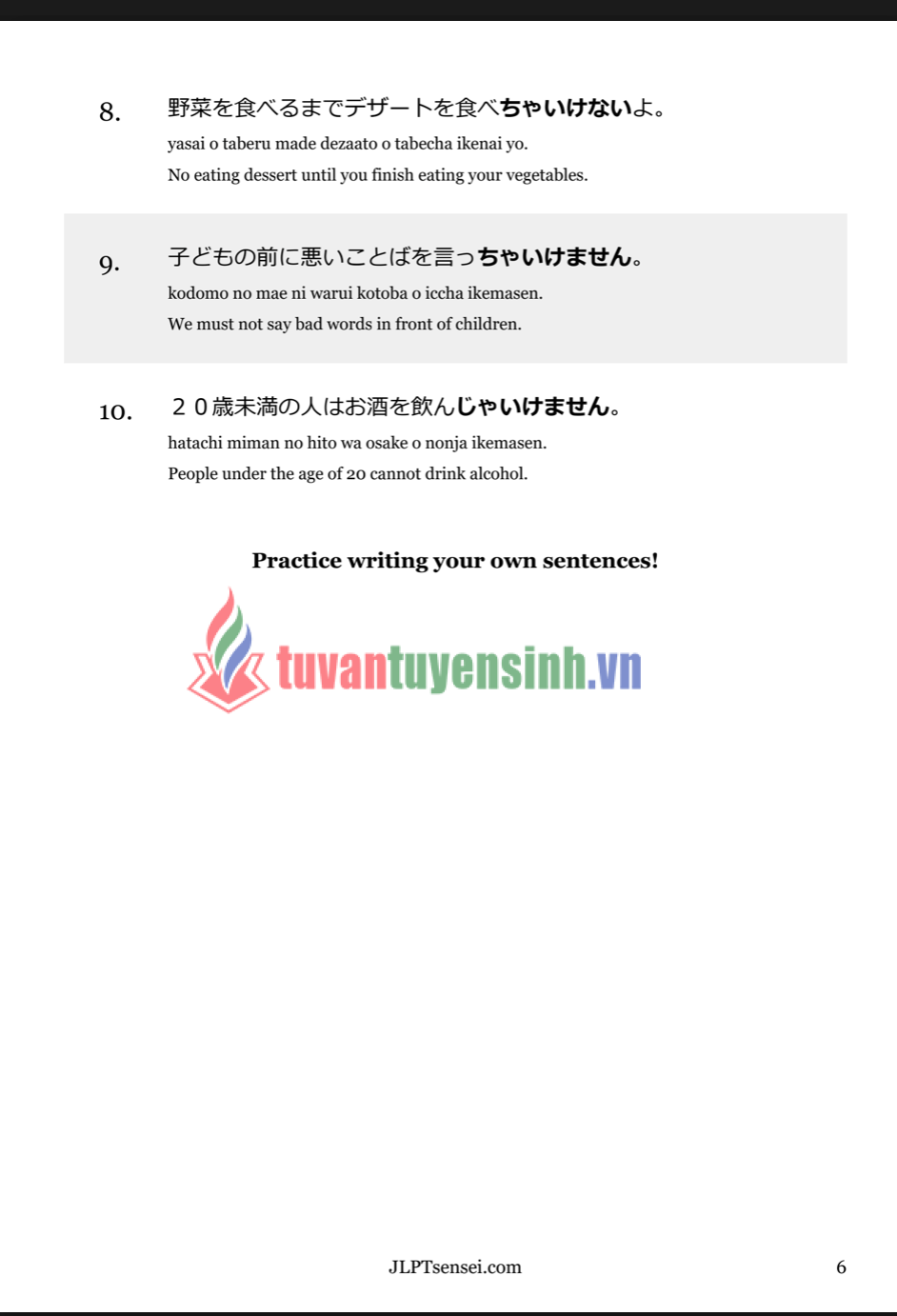
- 野菜を食べるまでデザートを食べちゃいけないよ。
yasai o taberu made dezaato o tabecha ikenai yo.
No eating dessert until you finish eating your vegetables. - 子どもの前に悪いことを言っちゃいけません。
kodomo no mae ni warui kotoba o iccha ikemasen.
We must not say bad words in front of children. - 20歳未満の人はお酒を飲んじゃいけません。
hatachi miman no hito wa osake o nonja ikemasen.
People under the age of 20 cannot drink alcohol.
Practice writing your own sentences!
Trang 7 (Bài 2: だ・です)
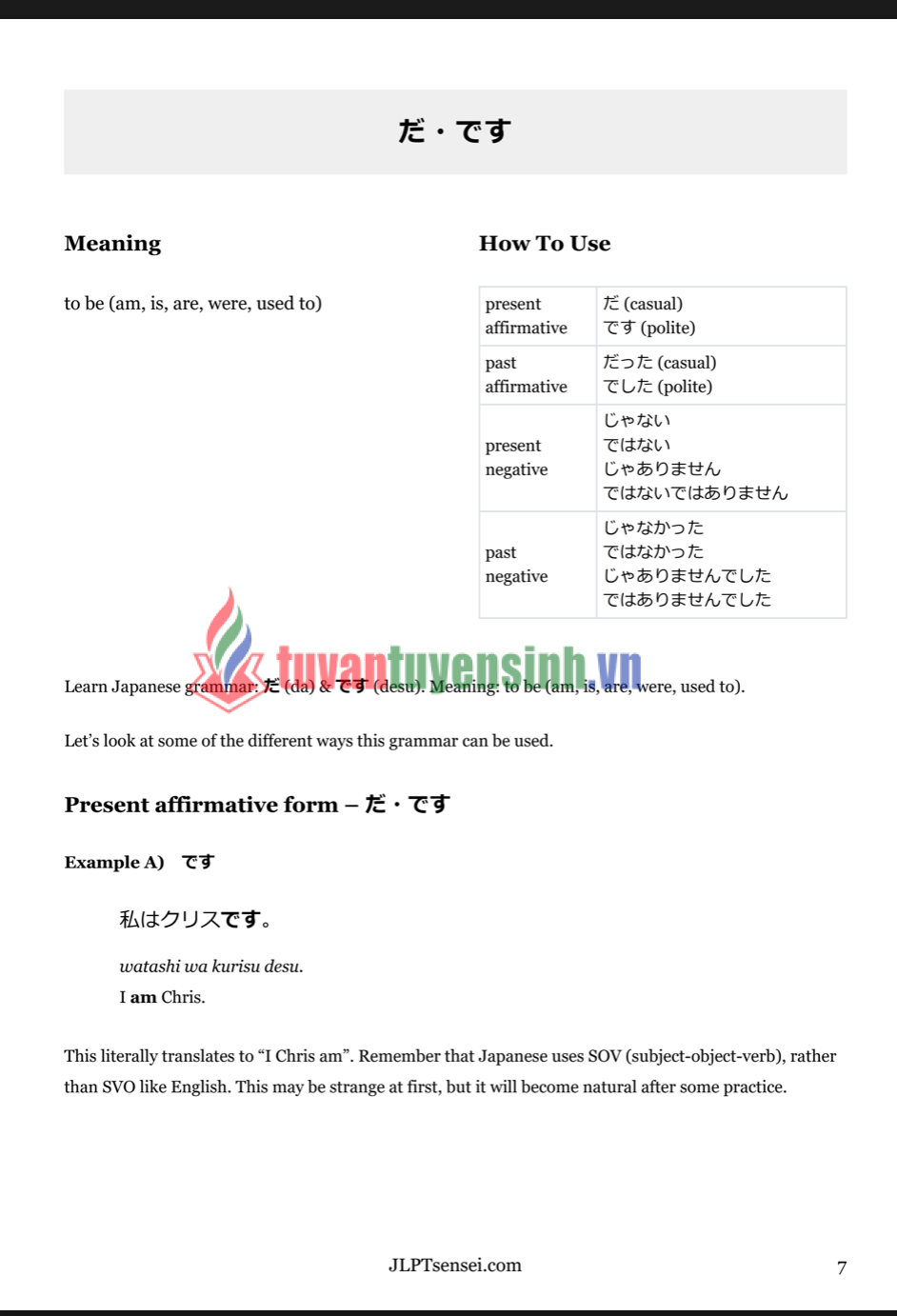
だ・です
Meaning
to be (am, is, are, were, used to)
How To Use
| present affirmative | だ (casual) |
| です (polite) | |
| past affirmative | だった (casual) |
| でした (polite) | |
| present negative | じゃない |
| ではない | |
| じゃありません | |
| ではありません | |
| past negative | じゃなかった |
| ではなかった | |
| じゃありませんでした | |
| ではありませんでした |
Learn Japanese grammar: だ (da) & です (desu). Meaning: to be (am, is, are, were, used to).
Let’s look at some of the different ways this grammar can be used.
Present affirmative form – だ・です
Example A) です
私はクリスです。
watashi wa kurisu desu.
I am Chris.
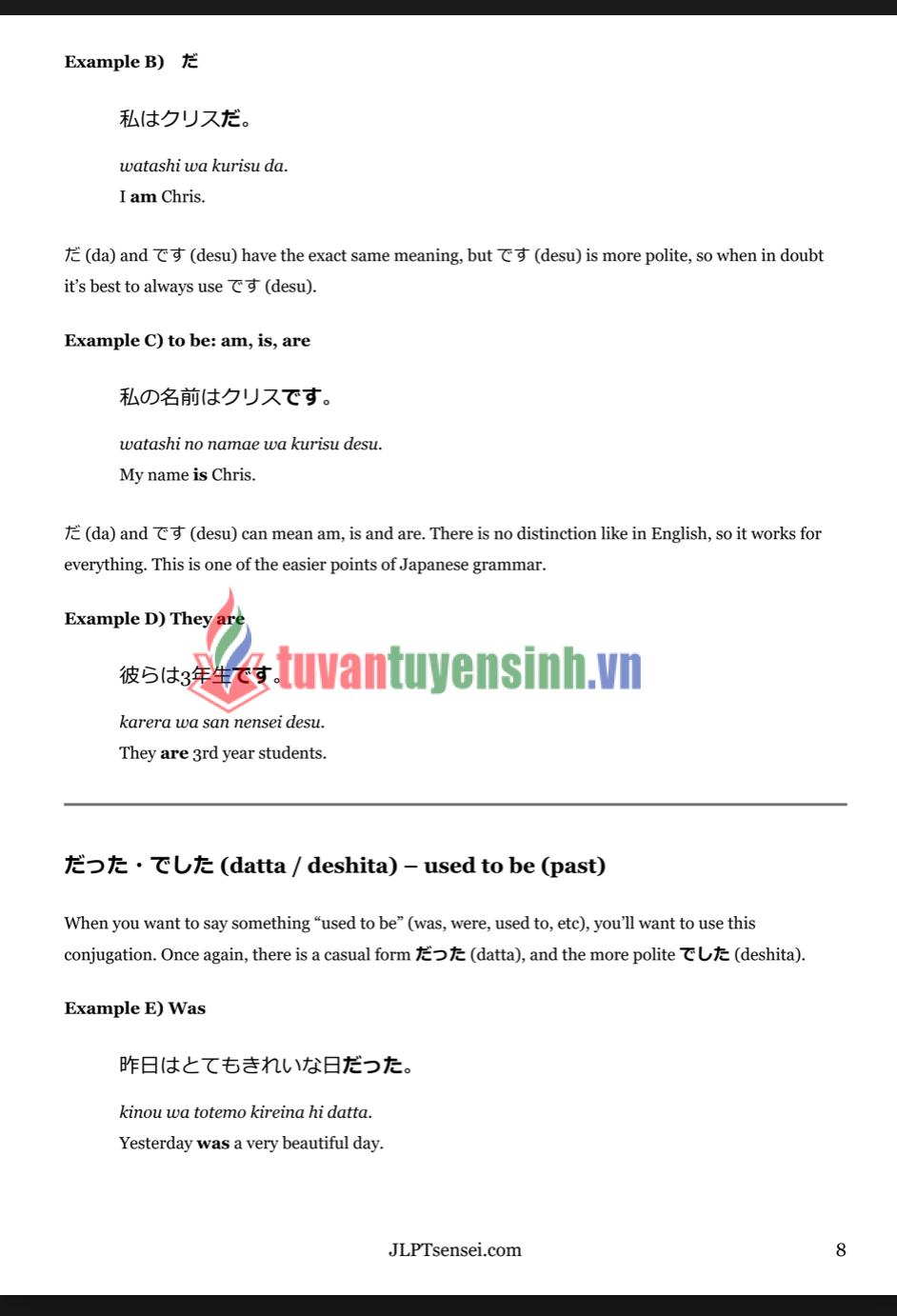
だ (da) and です (desu) have the exact same meaning, but です (desu) is more polite, so when in doubt it’s best to always use です (desu).
Example C) to be: am, is, are
私の名前はクリスです。
watashi no namae wa kurisu desu.
My name is Chris.
だ (da) and です (desu) can mean am, is and are. There is no distinction like in English, so it works for everything. This is one of the easier points of Japanese grammar.
Example D) They are
彼らは3年生です。
karera wa san nensei desu.
They are 3rd year students.
Trang 8 (Tiếp Bài 2 và Đoạn Chuyển Tiếp)
だった・でした (datta / deshita) – used to be (past)
When you want to say something “used to be” (was, were, used to, etc), you’ll want to use this conjugation. Once again, there is a casual form だった (datta), and the more polite でした (deshita).
Example E) Was
昨日はとてもきれいな日だった。
kinou wa totemo kireina hi datta.
Yesterday was a very beautiful day.
JLPTsensei.com
8
Trang 11 (Hướng dẫn truy cập bản dịch)
「例題と解き方」翻訳版について
如何获取 “例題 & 解答方法” 的翻译版
Hướng dẫn sử dụng bản dịch của phần “Câu hỏi ví dụ và cách trả lời”
Руководство к доступу русскоязычной версии «Примеров и способов решений»
以下の「URLにアクセスするか、スマートフォンやタブレットでコードを読み取ってアクセスしてください。
An English version of “Examples and Guide” is available. It can be accessed via the link below or by scanning the code with a scanning app on your smartphone or tablet.
“例題と解き方”这部分有汉语翻译版。请通过登录下面的网址,或通过用手机或平板电脑直接读取二维码来获取。
Phần “Câu hỏi ví dụ và cách trả lời” này có bản dịch Tiếng Việt. Để xem bản dịch, hãy truy cập từ đường dẫn bên dưới, hoặc truy cập bằng cách dùng điện thoại, máy tính bảng đọc mã code.
Для получения доступа к русскоязычной версии «Примеров и способов решений» перейдите по указанному ниже URL-адресу или отсканируйте QR-код с помощью смартфона или планшета.
[日本語 English]
https://bookclub2.japantimes.co.jp/download/files/N4\_reidai\_EN.pdf
[中國語 中文]
https://bookclub2.japantimes.co.jp/download/files/N4\_reidai\_CN.pdf
[ベトナム語 Tiếng Việt]
(Kèm theo mã QR)
https://bookclub2.japantimes.co.jp/download/files/N4\_reidai\_VN.pdf
[ロシア語 русский]
(Kèm theo mã QR)
https://bookclub2.japantimes.co.jp/download/files/N4\_reidai\_RU.pdf
Trang 12 (Thông tin xuất bản)
全科目攻略!JLPT日本語能力試験ベスト総合問題集 N4
Succeed in all sections! The Best Complete Workbook for the Japanese-Language Proficiency Test N4
2022年 9月 5日 初版発行
著者: 五十嵐香子・金澤美香子・杉山舞
発行者: 伊藤秀樹
発行所: 株式会社 ジャパンタイムズ出版
〒102-0082 東京都千代田区一番町2-2
番町第二TGビル 2F
ISBN978-4-7890-1816-6
Copyright © 2022 by Kyoko Igarashi, Mikako Kanazawa and Mai Sugiyama
All rights reserved. No part of this publication may be reproduced, stored in a retrieval system, or transmitted in any form or by any means, electronic, mechanical, photocopying, recording, or otherwise, without the prior written permission of the publisher.
First edition: September 2022
Narrators: Erika Umeda, Mai Kanade, Shogo Nakamura and Shinnosuke Iwamoto
Recordings: The English Language Education Council
Chinese translations: EXIM International, Inc.
Vietnamese translations: Nguyen Phuc Minh Tuyen
Russian translations: Sabina Zabirova
Illustrations: Eriko Ishibishi
Layout design and typesetting: DEP, Inc.
Typesetting: Soju Co., Ltd.
Cover design: Shohei Oguchi + Ryo Misawa + Tsukasa Goto (tobufune)
Printing: Nikkei Printing Inc.
Published by The Japan Times Publishing, Ltd.
2F Ichibancho Dainī TG Bldg., 2-2 Ichibancho, Chiyoda-ku, Tokyo 102-0082, Japan
Website: https://jtpublishing.co.jp
ISBN978-4-7890-1816-6
Printed in Japan
Trang 13 (はじめに – Preface)
はじめに
Preface
本書「全科目攻略!JLPT日本語能力試験ベスト総合問題集N4」は、日本語能力試験N4の合格を目指す日本語学習者のためのドリル問題集です。発音をバランスよく、計画的にしっかり学べる内容になっています。また、各項目にまとめてありますので、苦手科目を集中的に勉強することも出来ます。
各問題の形式は過去のJLPTに実際に出題されたものを参考にしました。語彙や文法は一般的なN4レベルに準じていますが、比較的に解きやすい問題から難易度の高い問題までをそろえることで、N5に合格したばかりの学習者から、N4の勉強を一遍通り終え、試験直前の腕試しをしたいという学習者まで幅広く対応できるようにしてあります。
著者一同、日本語学校での教授経験や試験の作問経験をもとに、重複を重ねて練り上げた問題です。また、初めてJLPTを受ける学習者にとってもわかりやすいように、各科目の初めに例題とともに、問題と解き方のポイントなどをまとめました。これらはJLPT対策の授業を担当される先生方にも、役に立つ内容です。
本書がN4合格を目指す方やN4レベルの日本語を教える先生方の手助けに一番になれば幸いです。
また、本書を出版するにあたり、的確なアドバイスをくださったジャパンタイムズ出版日本版日本語出版編集部の皆さんにも心から感謝いたします。このほか、本書の作成のためご協力くださいましたお一人お一人に厚くお礼申し上げます。
2022年8月
著者代表 五十嵐香子
金澤美香子
杉山 舞
Trang 14 & 15 (Hướng dẫn sử dụng)
Trang 14
本書の使い方 (Features and Usage of This Book)
本書は4つの学習リソース: ① 本冊, ② 別冊, ③ 音声, ④ 解説の4部で構成されています。
①問題
問題
日本語能力試験N4と同じ形式の問題が出題されます。各週、5日分の問題が収録されています。9週間で構成する構成になっています。第1週目を順に普段から進めてもいいですし、苦手な科目があればその部分から、始めてもいいでしょう。9週間から第9週目までの目標をまとめて、それぞれの解くべき問題に集中できるよう、各回を分けています。各週1回の復習のように使用することを避けます。
例題と解き方 (Examples and Guide)
言語知識、読解、聴解、解説、問題編の初めに、問題の解き方を例題付きで解説しています。問題に取り組む前に、ここを読んで解き方のポイントを確認しておきましょう。
言葉を覚えよう Vocabulary
N4レベルですべき言葉のリストです。言葉を覚えるために使ってください。
②別冊 (Supplement)
問題の解答がと答えと聴解のスクリプトが収録されています。スクリプトの中で、問題の答えになる部分には下線が引いてあります。
③音声 (Audio files)
聴解問題の音声は以下の方法でダウンロードできます。(音声は無料です。)
・コードを読み取って、「OTO Navi」をインストールし、音声をダウンロードしてください。
・パソコンの場合は以下のURLからmp3音声をダウンロードしてください。
https://bookclub.japantimes.co.jp/en/book/b605436.html
④解答 (Commentary)
問題の詳しい解答はPDFファイルで提供します。右のコードを読み取るか、以下のURLからBOOK CLUBにアクセスしてダウンロードしてください。
https://bookclub.japantimes.co.jp/en/book/b605436.html
Trang 15
図解:問題の構成 (Structure)
問題
- 言語知識 (Vocabulary / Grammar)
- 第1週:漢字読み / 語彙・文法
- 第2週:用法・助詞の組み立て
- 第3週:文法形式の判断・文章の文法
- 読解 (Reading)
- 第4週:内容理解 (短文)
- 第5週:内容理解 (中編)
- 第6週:情報検索
- 聴解 (Listening)
- 第7週:課題理解
- 第8週:ポイント理解
- 第9週:発話表現・即時応答
※実際の試験の出題順と異なります。
Trang 6 (Hướng dẫn sử dụng bằng Tiếng Anh)
Features and Usage of This Book
This book consists of four learning resources: a textbook, a supplement, audio files, and commentary.
① Textbook
問題 Exercises
This book presents exercises formatted in the same style as the test items appearing in level N4 of the Japanese Language Proficiency Test (JLPT), in the composition shown below. Each week consists of 5 days’ worth of exercises arranged for each week of this course which takes 9 weeks to complete. You can choose to start from the Week 1 Day