


Giới thiệu sách: Ngữ pháp và Câu mẫu N4 (Grammar and Model Sentences N4)
Cuốn sách “Ngữ pháp và Câu mẫu N4” (Grammar and Model Sentences N4) là tài liệu học tập cốt lõi, được thiết kế nhằm trang bị cho người học tiếng Nhật kiến thức ngữ pháp vững chắc, cần thiết để đạt được mục tiêu chinh phục cấp độ N4 của Kỳ thi Năng lực Tiếng Nhật (JLPT). Thường được xuất bản bởi các nhà xuất bản uy tín chuyên về tài liệu tiếng Nhật (như Sanshū, Ask, hay Bonjinsha, dựa trên mã số 1402 01), cuốn sách này tập trung vào việc xây dựng sự tự tin cho người học trong việc sử dụng ngôn ngữ Nhật Bản ở mức độ trung cấp sơ khởi.
Mục tiêu và Phạm vi Kiến thức
Cấp độ N4 yêu cầu người học không chỉ nắm vững các cấu trúc ngữ pháp cơ bản của N5 mà còn phải hiểu và sử dụng thành thạo khoảng 140 đến 170 cấu trúc ngữ pháp mới, bao gồm các thể bị động, sai khiến, điều kiện, lý do phức tạp hơn, và các hình thức kính ngữ (keigo) sơ cấp. Cuốn sách này bao quát toàn bộ phạm vi ngữ pháp chính thức của JLPT N4.
Phương pháp Học tập Tích hợp
Điểm mạnh lớn nhất của tài liệu này nằm ở sự kết hợp hài hòa giữa việc giải thích ngữ pháp và cung cấp ví dụ thực tế (Model Sentences), đảm bảo học viên không chỉ ghi nhớ công thức mà còn hiểu rõ cách áp dụng chúng trong giao tiếp.
1. Giải thích Ngữ pháp Rõ ràng và Chi tiết:
Mỗi điểm ngữ pháp mới thường được trình bày theo một cấu trúc chuẩn hóa, bao gồm:
- Công thức cấu tạo: Chỉ rõ cách kết hợp với các loại từ khác nhau (danh từ, động từ thể ta, thể nai, tính từ i, tính từ na).
- Ý nghĩa và chức năng: Giải thích chính xác ý nghĩa của cấu trúc (ví dụ: nguyên nhân, mục đích, sự so sánh, sự xin phép) và sắc thái ý nghĩa mà nó truyền tải.
- Phân biệt: Các cấu trúc tương đồng nhưng khác biệt về sắc thái hoặc cách dùng (ví dụ: phân biệt giữa 〜なければならない và 〜なくてはいけない) thường được làm rõ.
2. Câu Mẫu Thực tế và Gần gũi:
Ngữ pháp được củng cố thông qua các câu mẫu (Model Sentences). Những câu này được xây dựng dựa trên các tình huống thường gặp trong đời sống, công việc, hoặc các đoạn hội thoại đời thường, giúp người học:
- Thấy được ngữ pháp được sử dụng như thế nào trong bối cảnh thực tế.
- Dễ dàng ghi nhớ ngữ pháp thông qua việc liên kết với tình huống cụ thể, thay vì chỉ học thuộc lòng công thức khô khan.
3. Cấu trúc Bài học Khoa học:
Sách thường được chia thành nhiều đơn vị bài học nhỏ (khoảng 10-15 bài), cho phép người học tiếp thu kiến thức một cách từ từ và chắc chắn. Sau mỗi nhóm ngữ pháp, cuốn sách thường tích hợp các phần luyện tập:
- Luyện tập Điền khuyết (Fill-in-the-blanks): Để kiểm tra khả năng áp dụng công thức.
- Luyện tập Sắp xếp câu (Sentence Ordering): Nhằm rèn luyện kỹ năng sắp xếp từ ngữ tự nhiên.
- Bài kiểm tra tổng hợp (Wrap-up Test): Củng cố kiến thức của cả chương trước khi chuyển sang chương mới.
Lợi ích Khi Sử dụng Sách
Sử dụng cuốn sách này sẽ giúp người học:
- Nắm vững Ngữ pháp N4: Đảm bảo không bỏ sót bất kỳ cấu trúc quan trọng nào cần thiết cho kỳ thi JLPT N4.
- Tăng cường Kỹ năng Đọc hiểu: Sự hiểu biết sâu sắc về ngữ pháp là chìa khóa để giải quyết các bài đọc hiểu cấp độ trung cấp.
- Cải thiện Kỹ năng Viết và Nói: Thông qua việc nghiên cứu các câu mẫu, người học có thể tự tin hơn khi diễn đạt ý kiến cá nhân bằng tiếng Nhật.
Tóm lại, “Ngữ pháp và Câu mẫu N4” là người bạn đồng hành không thể thiếu, cung cấp nền tảng ngữ pháp vững chắc, là bước đệm quan trọng để người học tiến lên cấp độ N3 và xa hơn trong hành trình chinh phục ngôn ngữ Nhật Bản.
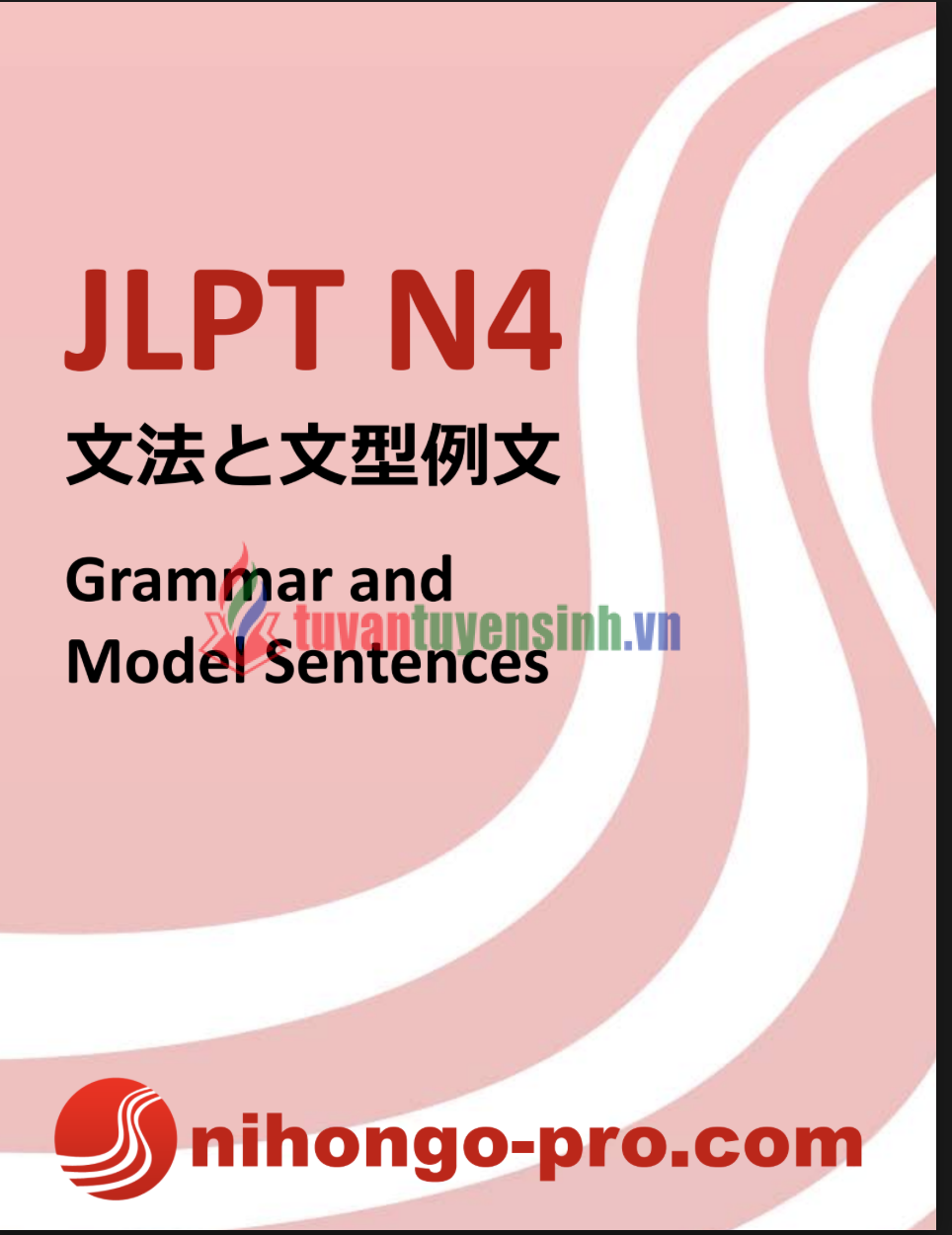
Trang 1 (Bìa sách)
JLPT N4
文法と文型例文
Grammar and Model Sentences
(Logo) nihongo-pro.com
Trang 2 (Tài liệu giới thiệu)
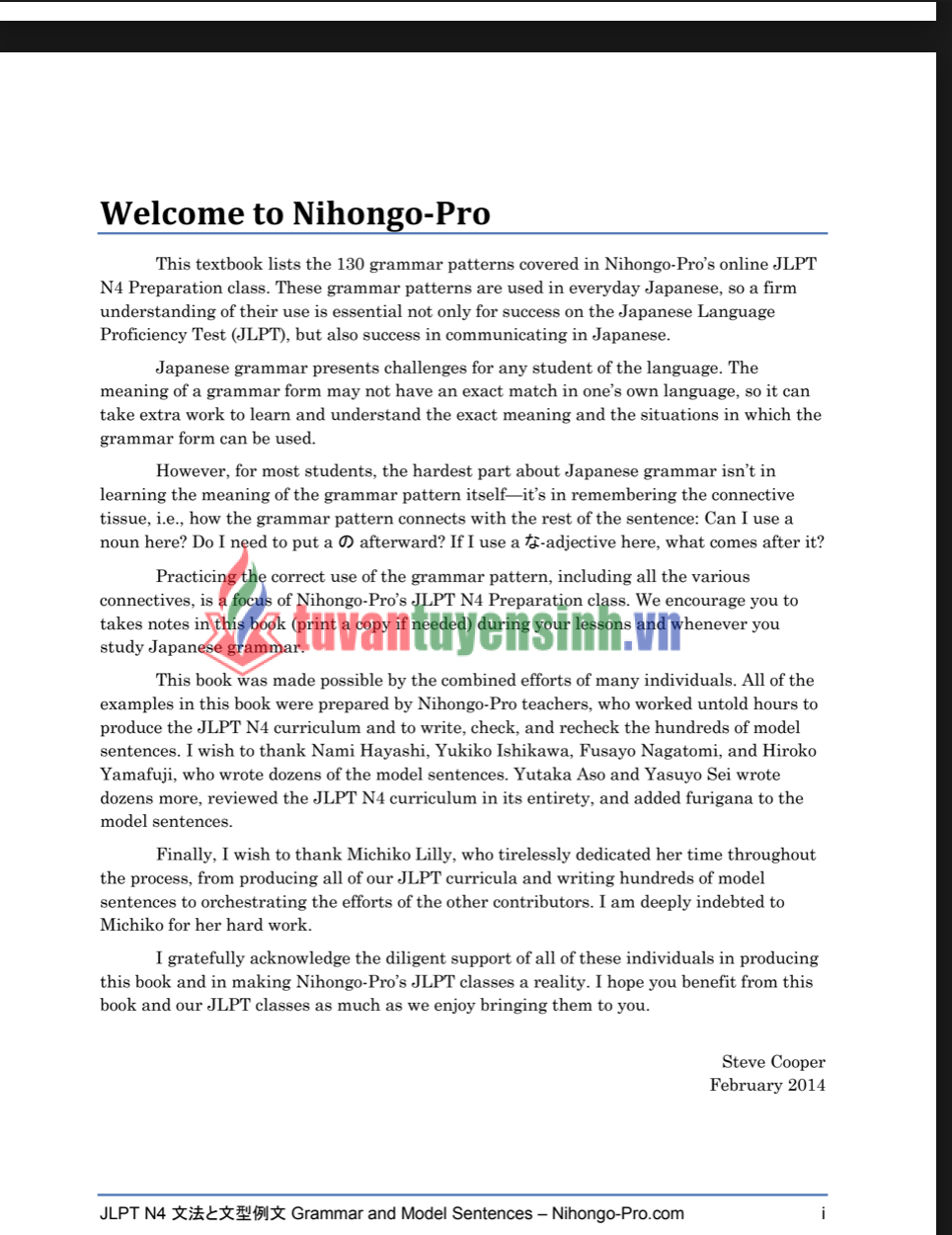
Welcome to Nihongo-Pro
This textbook lists the 130 grammar patterns covered in Nihongo-Pro’s online JLPT N4 Preparation class. These grammar patterns are used in everyday Japanese, so a firm understanding of their use is essential not only for success in the Japanese Language Proficiency Test (JLPT), but also success in communicating in Japanese.
Japanese grammar presents challenges for any student of the language. The meaning of a grammar pattern may not have an exact match in one’s own language, so it can take extra work to learn and understand the exact meaning and the situations in which the grammar pattern can be used.
However, for most students, the hardest part about Japanese grammar isn’t in learning the meaning of the grammar pattern itself—it’s in remembering the connective tissue, i.e., how the grammar pattern connects with the rest of the sentence: Can I use a noun here? Do I need to put a の afterward? If I use a て-adjective here, what comes after it?
Practicing the correct use of the grammar pattern, including all the various connectives, is a focus of Nihongo-Pro’s JLPT N4 Preparation class. We encourage you to take notes in this book (print a copy if needed) during your lessons and whenever you study Japanese grammar.
This book was made possible by the combined efforts of many individuals. All of the examples in this book were prepared by Nihongo-Pro teachers
…who worked untold hours to produce the JLPT N4 curriculum and to write, check, and recheck the hundreds of model sentences. I wish to thank Nami Hayashi, Yukiko Ishikawa, Fusayo Nagatomi, and Hiroko Yamafuji, who wrote dozens of the model sentences. Yutaka Aso and Yasuyo Sei wrote dozens more, reviewed the JLPT N4 curriculum in its entirety, and added furigana to the model sentences.
Finally, I wish to thank Michiko Lilly, who tirelessly dedicated her time throughout the process, from producing all of our JLPT curricula and writing hundreds of model sentences to orchestrating the efforts of the other contributors. I am deeply indebted to Michiko for her hard work.
I gratefully acknowledge the diligent support of all of these individuals in producing this book and in making Nihongo-Pro’s JLPT classes a reality. I hope you benefit from this book and our JLPT classes as much as we enjoy bringing them to you.
Steve Cooper
February 2014
JLPT N4 文法と文型例文 Grammar and Model Sentences – Nihongo-Pro.com (i)
Trang 3 (Tài liệu cấu trúc sách)
Structure of This Book
Each of the 130 JLPT N4 grammar patterns listed separately, in the order the grammar patterns are presented in our JLPT N4 Preparation class. For each pattern, the following information is included:
- 文型 (Pattern): The grammar pattern (e.g., 「〜ところだ」).
- 文型番号 (Pattern Number): The grammar pattern number. These numbers appear in the teachers’ lesson plans for the JLPT N4 Preparation.
- 英訳 (English): The approximate English meaning of the grammar pattern.
- 接続 (Connectives): How this grammar pattern connects to other elements in the sentence. See the Reference of Connectives (below) for more details.
- 例文 (Examples): Examples using the grammar pattern. These model sentences use a variety of the connectives and make an excellent study and review tool.
- ノート (Note): Space for your own notes. We encourage you to keep track of when you studied each grammar pattern and rate your level of understanding.
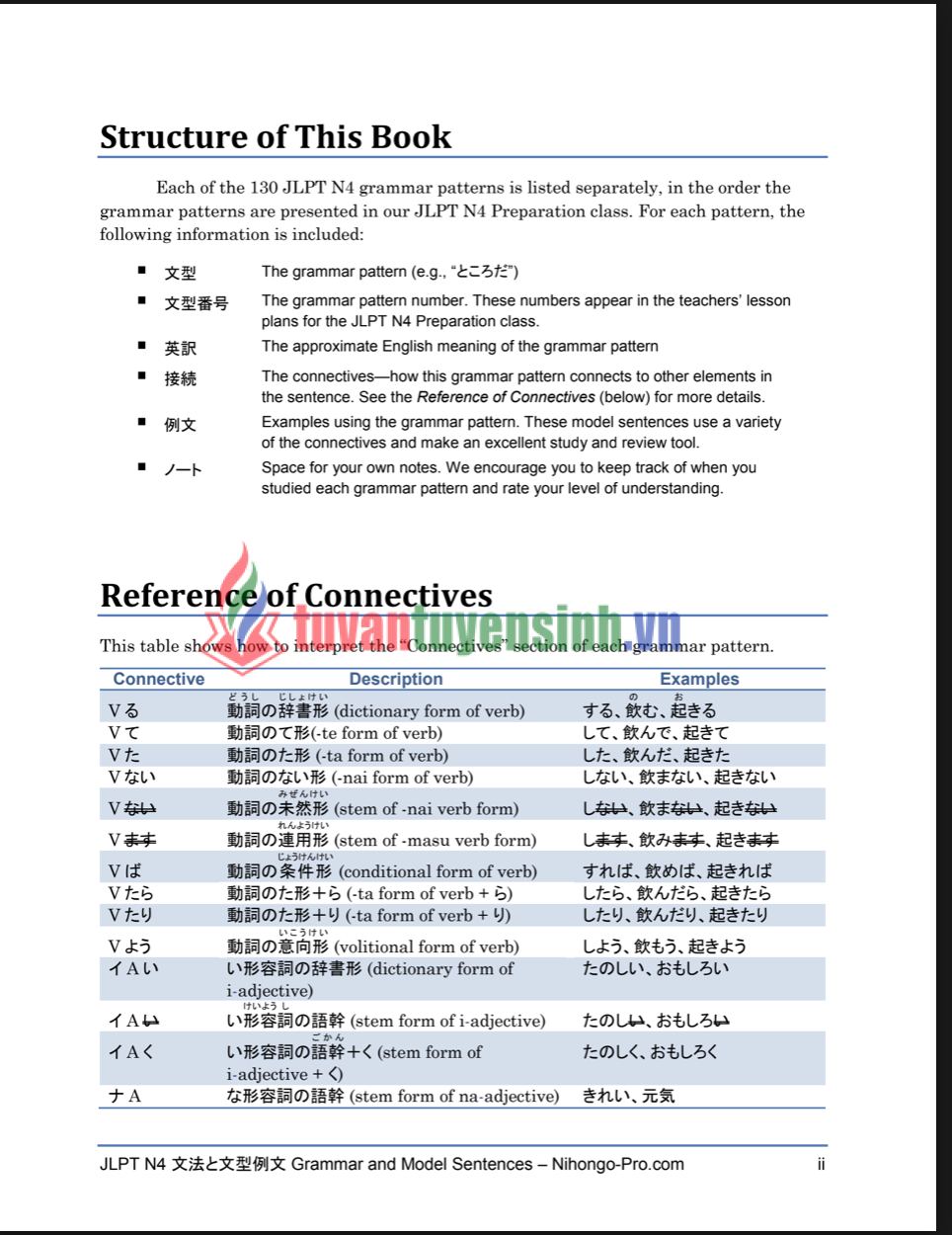
Reference of Connectives (Tham chiếu về các Liên kết)
This table shows how to interpret the “Connectives” section of each grammar pattern.
| Connective | Description (Mô tả) | Examples (Ví dụ) |
| V る | 動詞の辞書形 (dictionary form of verb) | する、飲む、起きる |
| V て | 動詞のて形 (-te form of verb) | して、飲んで、起きた |
| V た | 動詞のた形 (-ta form of verb) | した、飲んだ、起きた |
| V ない | 動詞のない形 (-nai form of verb) | しない、飲まない、起きない |
| V ます | 動詞の未然形 (stem of -masu verb form) | しない、飲まない、起きない |
| V まま | 動詞の連用形 (stem of -masu verb form) | しまま、飲みまま、起きまま |
| V ば | 動詞の仮定形 (conditional form of verb) | すれば、飲めば、起きれば |
| V たら | 動詞のた形+ら (ta form of verb + ら) | したら、飲んだら、起きたら |
| V たり | 動詞のた形+り (ta form of verb + り) | したり、飲んだり、起きたり |
| V よう | 動詞の意向形 (volitional form of verb) | しよう、飲もう、起きよう |
| i A い | い形容詞の辞書形 (dictionary form of i-adjective) | たのしい、おもしろい |
| i A く | い形容詞の語幹 (stem form of i-adjective) | たのしく、おもしろく |
| i A くて | い形容詞の語幹+くて (stem form of i-adjective + くて) | たのしくて、おもしろくて |
| な A | な形容詞の語幹 (stem form of na-adjective) | きれい、元気 |
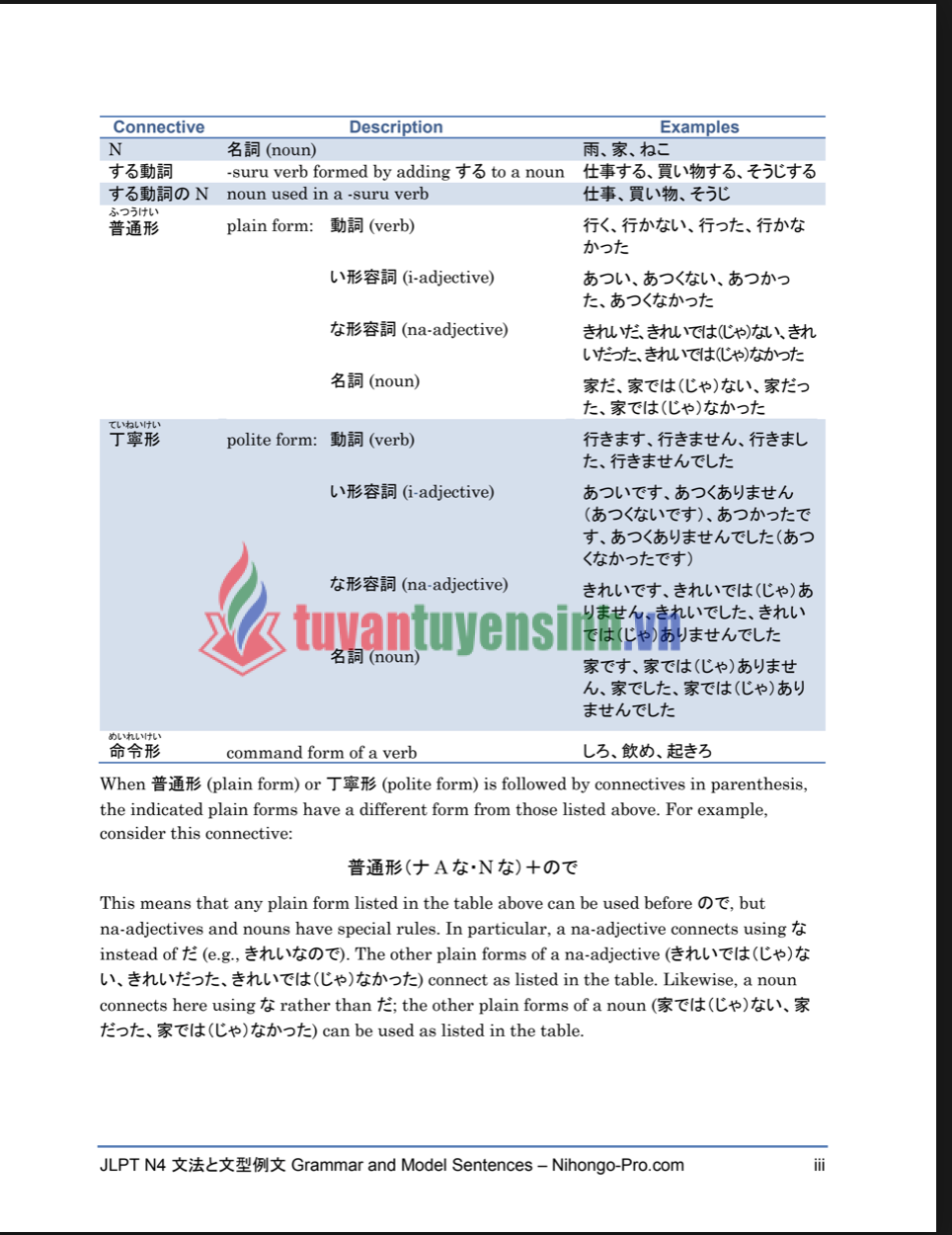
| する動詞 N | -suru verb formed by adding する to a noun | 雨、家、ねこ |
| する動詞の N | noun used in a -suru verb | 仕事、買い物、そうじする |
| 普通形 | plain form (verb) | 行く、行かない、行った、行かなかった |
| 普通形 | い形容詞 (i-adjective) | あつい、あつくない、あったか、あつかった |
| 普通形 | な形容詞 (na-adjective) | きれいだ、きれいではない、きれいだった、きれいではなかった |
| 普通形 | 名詞 (noun) | 家だ、家ではない、家だった、家ではなかった |
| 丁寧形 | polite form (verb) | 行きます、行きません、行きました、行きませんでした |
| 丁寧形 | い形容詞 (i-adjective) | あついです、あつくありません、あつかったです、あつくありませんでした |
| 丁寧形 | な形容詞 (na-adjective) | きれいです、きれいではありません、きれいでした、きれいではありませんでした |
| 丁寧形 | 名詞 (noun) | 家です、家ではありません、家でした、家ではありませんでした |
When 普通形 (plain form) or 丁寧形 (polite form) is followed by connectives in parenthesis, consider this connective:
普通形 (Plain Form + な A・な N) + ので
This means that any plain form listed above can be used before ので, but na-adjectives and nouns have special rules. In particular, a na-adjective connects using な instead of て (e.g., きれいな ので). The other plain forms of a na-adjective (きれいで (は) ないので、きれいだった、きれいだった) connect as written in the table. Likewise, a noun connects here using な rather than て; the other plain forms of a noun (家で(は)ない)ので、家だった、家では (じゃ) なかった) can be used as listed in the table.
JLPT N4 文法と文型例文 Grammar and Model Sentences – Nihongo-Pro.com (ii, iii)
Trang 1 (Mẫu ngữ pháp 1)
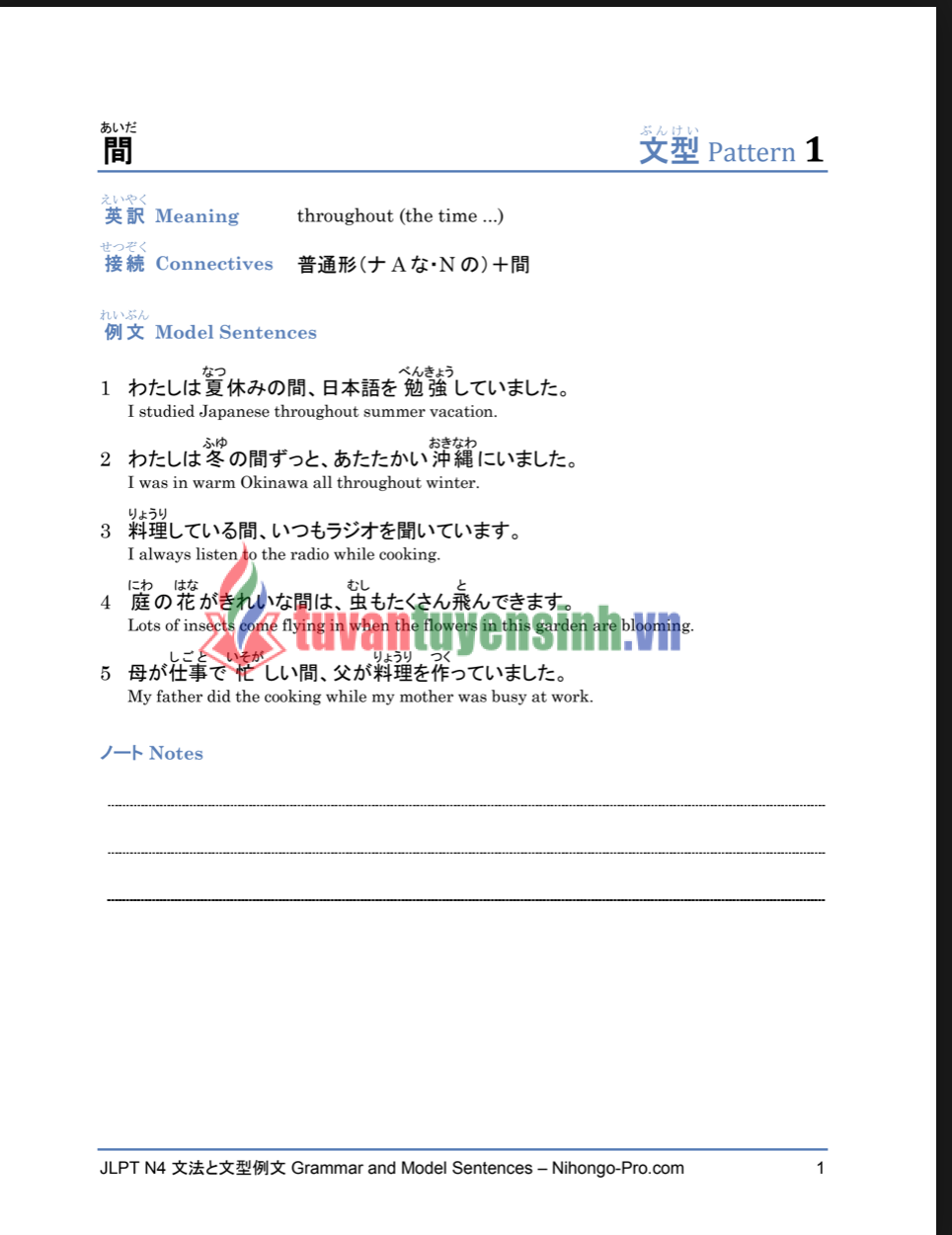
文型 Pattern 1
たら (tara)
- 英訳 (Meaning): throughout (the time …)
- 接続 (Connectives): 普通形 (Plain form) + な A・な N + の + 間
例文 (Model Sentences)
- わたし は なつやすみ の あいだ、にほんご を べんきょう しました。
I studied Japanese throughout summer vacation. - わたし は ふゆ の あいだ、おきなわ に いました。
I was in warm Okinawa all throughout winter. - りょうり して いる あいだ、いつも ラジオ を きいて います。
I always listen to the radio while cooking. - にわ の はな が きれい な あいだ は、むし が とん で きます。
Lots of insects come flying in when the flowers in this garden are blooming. - はは が しごと で いそがしい あいだ、ちち が りょうり を つくって いました。
My father did the cooking while my mother was busy at work.
ノート (Notes)
(Phần để ghi chú)
JLPT N4 文法と文型例文 Grammar and Model Sentences – Nihongo-Pro.com (1)
Trang 2 (Mẫu ngữ pháp 2)
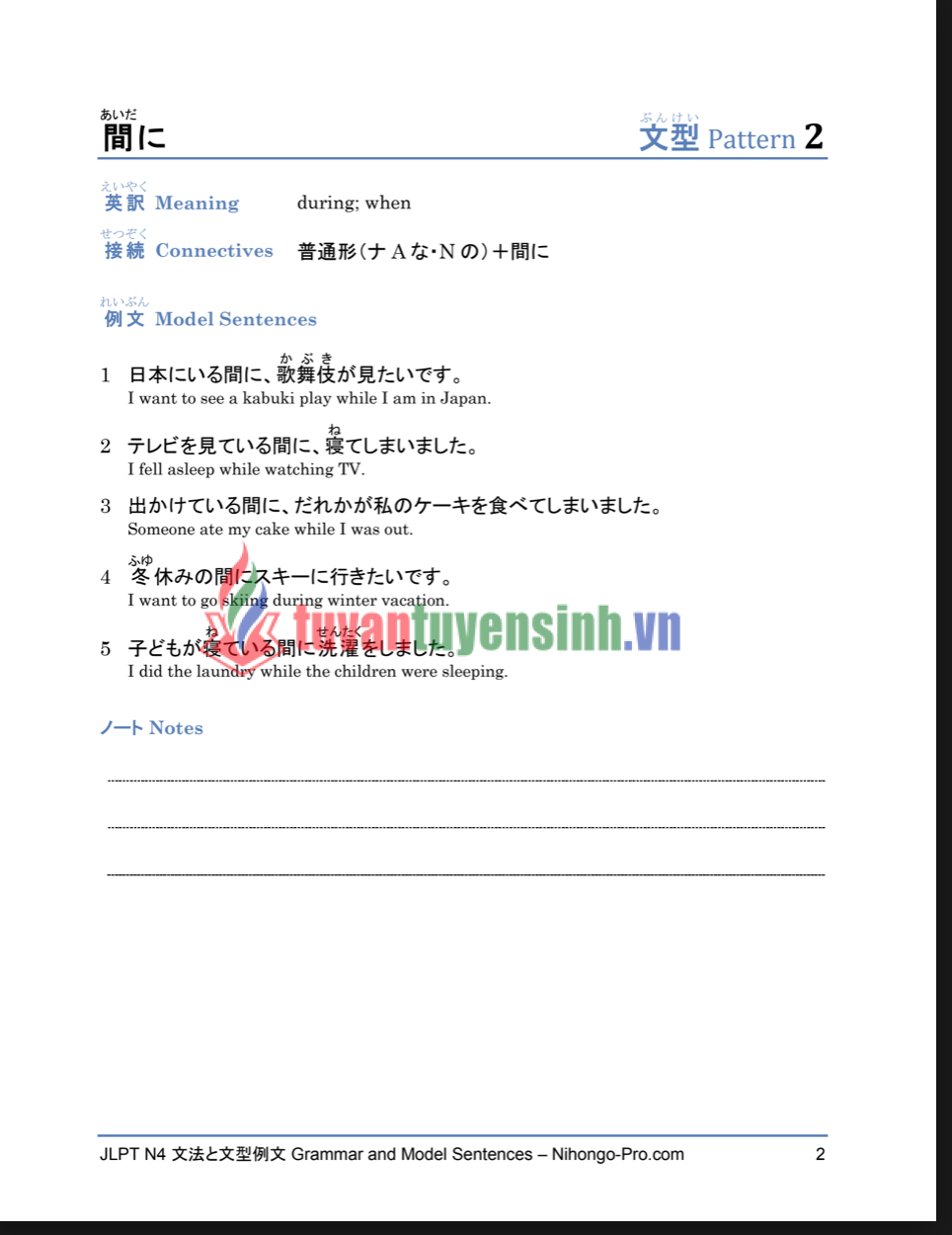
文型 Pattern 2
間に (aida ni)
- 英訳 (Meaning): during; when
- 接続 (Connectives): 普通形 (Plain form) + な A・な N・の + 間 に
例文 (Model Sentences)
- にほん に いる あいだ に、かぶき を みたい です。
I want to see a kabuki play while I am in Japan. - テレビをみている あいだに、ねて しまいました。
I fell asleep while watching TV. - でかける さいに、だれかがわたしのケーキをたべて しまいました。
Someone ate my cake while I was out. - ふゆやすみ の あいだ に スキー に いきたい です。
I want to go skiing during winter vacation. - こども が ねている あいだ に せんたく を しました。
I did the laundry while the children were sleeping.
ノート (Notes)
(Phần để ghi chú)
JLPT N4 文法と文型例文 Grammar and Model Sentences – Nihongo-Pro.com (2)
Trang 3 (Mẫu ngữ pháp 3)
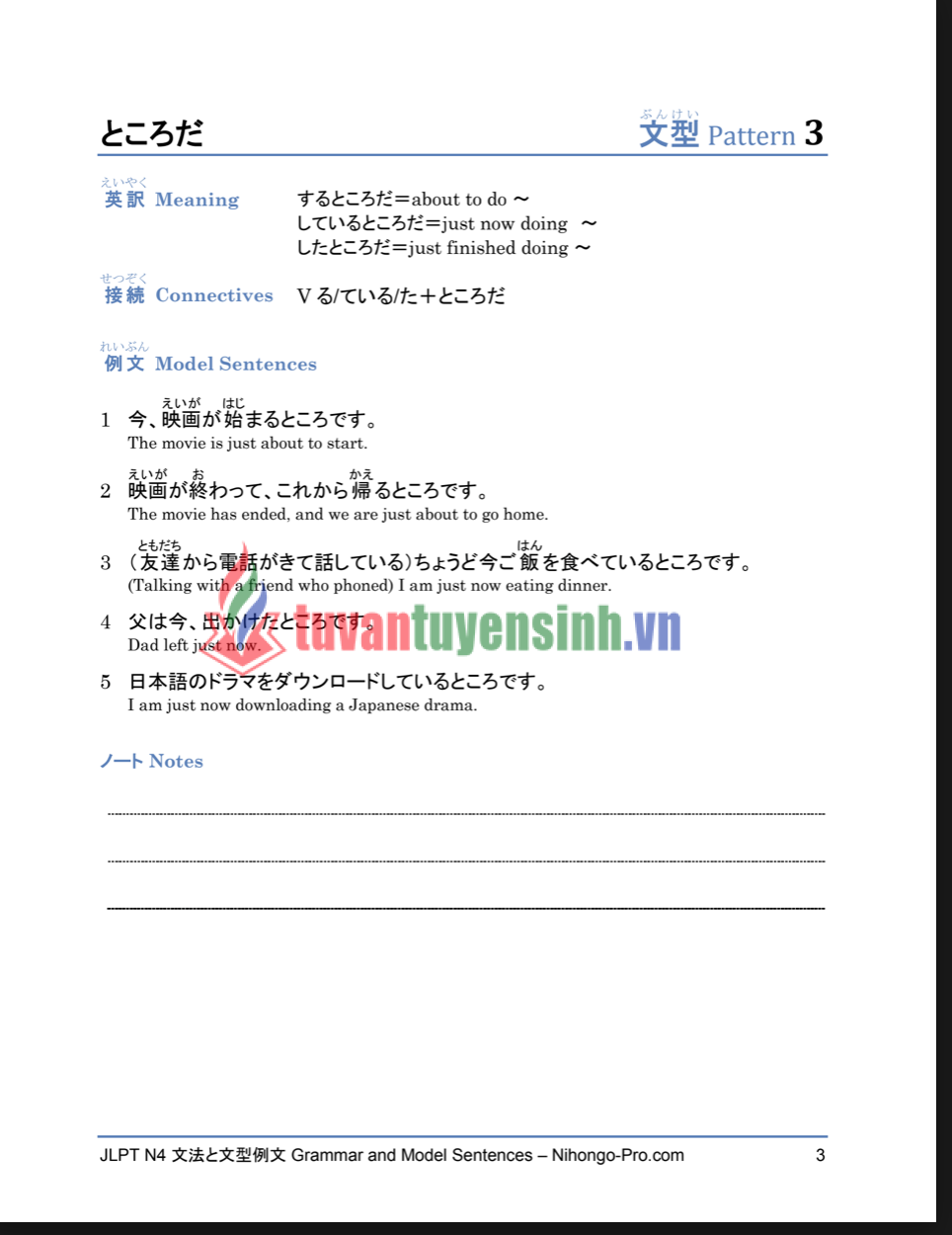
文型 Pattern 3
ところだ (tokoro da)
- 英訳 (Meaning): about to do 〜 / just now doing 〜 / just finished doing 〜
- 接続 (Connectives): V る/ている/た + ところ だ
例文 (Model Sentences)
- いま、えいが が はじまる ところ です。
The movie is just about to start. - えいが が おわって、これからかえるところです。
The movie has ended, and we are just about to go home. - (ともだち から でんわ で はなして いる)ちょうど いま ごはん を たべて いる ところ です。
(Talking with a friend who phoned) I am just now eating dinner. - ちち は いま、でかけたところです。
Dad left just now. - にほんご の ドラマ を ダウンロードして いる ところ です。
I am just now downloading a Japanese drama.
ノート (Notes)
(Phần để ghi chú)
JLPT N4 文法と文型例文 Grammar and Model Sentences – Nihongo-Pro.com (3)
Trang 4 (Mẫu ngữ pháp 4)
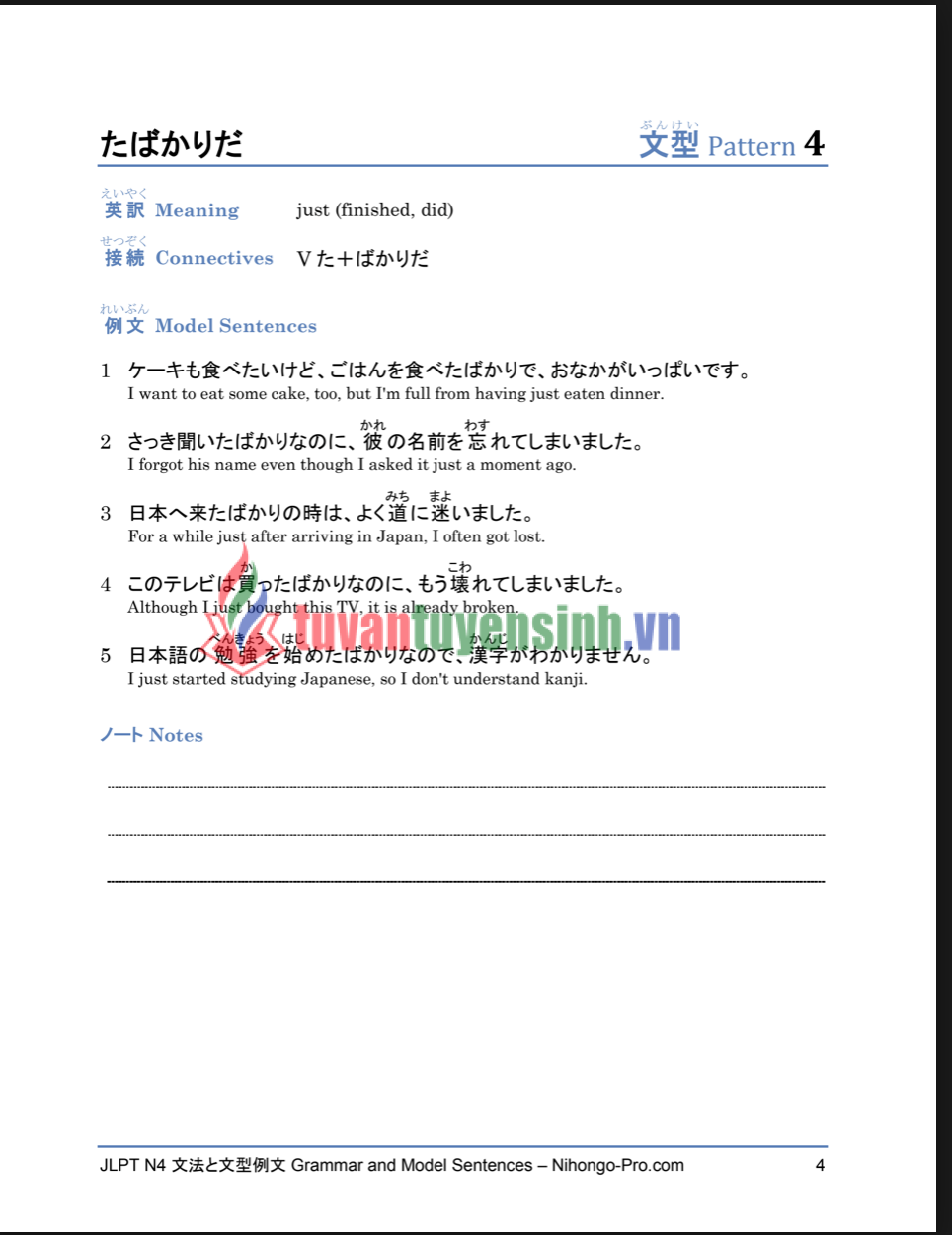
文型 Pattern 4
ばかりだ (bakari da)
- 英訳 (Meaning): just (finished, did)
- 接続 (Connectives): V た + ばかり だ
例文 (Model Sentences)
- ケーキ を たべたい けど、ごはん を たべた ばかり で、おなかいっぱい です。
I want to eat some cake, too, but I’m full from having just eaten dinner. - さっき きいた ばかり な のに、かれ の なまえ を わすれて しまいました。
I forgot his name even though I asked it just a moment ago. - にほん へ きた ばかり の とき は、よく みち に まよいました。
For a while just after arriving in Japan, I often got lost. - このテレビ を かった ばかり な のに、もう こわれて しまいました。
Although I just bought this TV, it is already broken. - にほんご の べんきょう を はじめ た ばかり な ので、かんじ が わかりません。
I just started studying Japanese, so I don’t understand kanji.
ノート (Notes)
(Phần để ghi chú)
JLPT N4 文法と文型例文 Grammar and Model Sentences – Nihongo-Pro.com (4)
Trang 5 (Mẫu ngữ pháp 5)
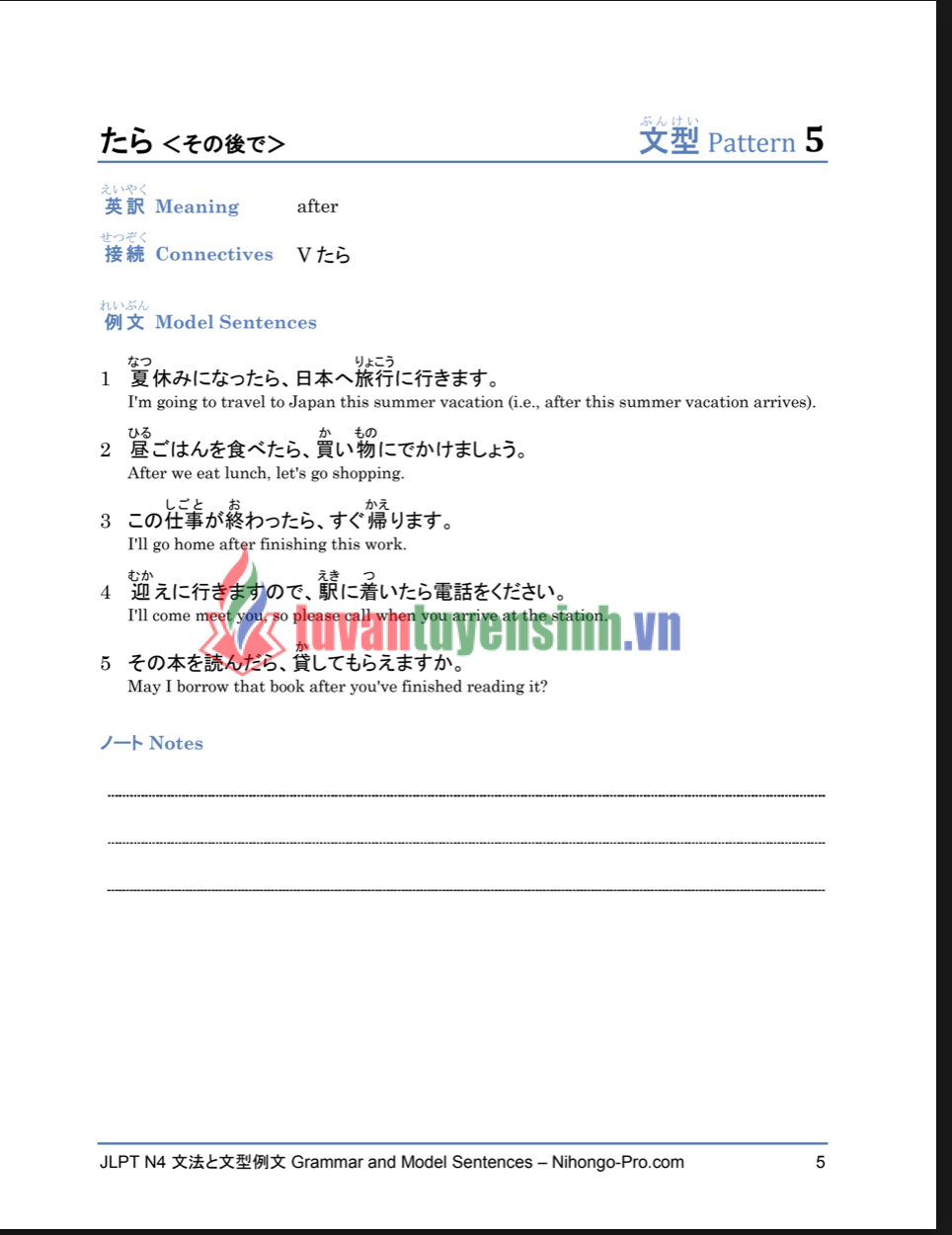
文型 Pattern 5
たら (tara)
- 英訳 (Meaning): after
- 接続 (Connectives): V たら
例文 (Model Sentences)
- なつやすみ に なったら、にほん へ りょこう に いきます。
I’m going to travel to Japan this summer vacation (i.e., after this summer vacation arrives). - ひる ごはん を たべたら、かいもの に でかけましょう。
After we eat lunch, let’s go shopping. - このしごとがおわったら、すぐ かえります。
I’ll go home after finishing this work. - むかえにいきますので、えきについたら でんわ を ください。
I’ll come meet you, so please call when you arrive at the station. - そのほんをよんだら、かして もらえますか。
May I borrow that book after you’ve finished reading it?
ノート (Notes)
(Phần để ghi chú)
JLPT N4 文法と文型例文 Grammar and Model Sentences – Nihongo-Pro.com (5)